Sunday, March 22, 2015

Chiseling on a road

There are a couple of ways to chisel your way to building a road.

Sydney, and much of urban Australia, paid through the nose for toll roads to make the daily grind of commuters more convenient, as Guambat has noted on more than one occasion.

My how that effort is just so unspeakably mercenary compared to the work of one man, Dashrath Manjhi.
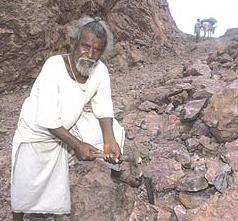
Manjhi started off his extraordinary task in 1960, after his wife was injured while trekking up the side of one of the rocky footpaths leading from his remote village in India to take food to him where he was gathering wood. To reach the nearest hospital, he had to travel around the mountains, some 70 kilometers.

His quest to break a path through a small mountain to benefit the entire village is now legendary because he carved an entire road with hand tools, working for 22 years.

He sold the family’s three goats to buy the hammer and chisels and worked every day on the project to make it a successful. After plowing fields for others in the morning, he would work on his road all evening and throughout the night.

Armed with only a sledge hammer, chisel, and crowbar, he single-handedly began carving a road through the 300-foot mountain that isolated his village from the nearest town.

With sides 25 feet high, the road is 30 feet wide and 360 feet in length. Because of his singular dedication, the distance to public services was reduced from 70km to just one.


Read and see more of this remarkable man who selflessly chiseled a road and broke a mountain to provide a lasting benefit to his community here.

And read more of the remarkable men and women who selfishly chiseled their way to a road and broke a lot of  people to provide questionable benefits to their community here.

Labels: , , ,

Friday, October 28, 2005

The tunnel or the shaft?

The Sydney Cross City Tunnel drama is turning to farce. After the State Government said it would not then said it would reveal all the contracting details (http://guambatstew.blogspot.com/2005/10/i-can-see-clearly-now.html), it turns out it didn't. In fact there appears to have been a little "side agreement" that allowed the contractors to bump up the toll, and this was not revealed.

The Minister in charge of Roads at the time the deal was done, and who signed off on it, is still a Minister, but in a different portfolio, so of course it was not his bad when the side deal wasn't revealed. So what does any responsible Government do? I wouldn't have a clue. Haven't seen one of those in yonks, so I don't have anything to go on.

But what this Government has done is shoot the Senior Civil Servant in charge of the Roads and Traffic Authority. Well not actually. Like Ms Miers, he tendered his resignation , and they accepted it. (http://www.smh.com.au/news/national/rta-boss-quits-over-tunnel-fiasco/2005/10/27/1130400311081.html) Well, not actually that, either. I'm hearing that he still has his same civil service classification with his $400,000+/year salary and is waiting out the heat in another chair.

And to add futher salt to the taxpayers' wound, it turns out the whole process of getting these PPPs is flawed because the Government has failed to implement even the simplest form of cost analysis that it was meant to have.

This from yesterday's SMH (http://www.smh.com.au/news/national/wrong-method-costing-state-billions-report/2005/10/26/1130302838987.html):

"In deciding whether to enter a public-private partnership to build and operate projects such as the Cross City Tunnel, the Government produces a document called a public sector comparator, which is the hypothetical cost of the Government delivering the project. While the Government promised in 2001 it would publish the comparator and the assumptions used to calculate it, the report says this has not happened and is a matter of "deep concern".

"NSW taxpayers may have lost billions of dollars in recent years because the Government uses a flawed method to calculate the cost of the public sector delivering new infrastructure such as the Cross City Tunnel, a report says.
The report, written for Unions NSW by a Sydney University accounting professor, Bob Walker, and a former NSW Treasury economist, Betty Con Walker, argues that in its effort to avoid public borrowings, the Government overstates the real cost of the public sector delivering projects such as the tunnel.

"The evidence "suggests that bureaucrats trying to avoid government borrowings means that the public pays a higher price for a whole range of public infrastructure and after about 15 years of experience the public service is still on a flat learning curve", the authors found. Professor Walker said: "Setting up deals that are no cost to Government means they are high cost to the public."

"The report, to be submitted to a parliamentary accounts committee investigating public-private partnerships says the guidelines used by Government to work out the cost of public-funded projects "reflect a systematic bias against conventional public sector delivery". Professor Walker said the State Government had access to cheaper money than the private sector and did not need to pay state taxes - but these advantages were not included when bureaucrats calculated the cost of the state building projects such as the tunnel."

The State Government is running so hard to to deflect the headlines from the scandals this is revealing that it is even backing down on its "get tougher" on terror policy deal it did with Howard, (http://www.smh.com.au/news/national/cracks-in-terror-solidarity/2005/10/27/1130400311063.html).

Labels:

Monday, October 24, 2005

Highway robbery?

With the new Sydney cross-city tunnel controversy (see http://guambatstew.blogspot.com/2005/10/i-can-see-clearly-now.html ) "people have asked why the State Government has leased us out. Why have the private sector deliver public infrastructure when the Government can borrow funds more cheaply?

"These partnerships are being pursued to improve the procurement of public infrastructure. Given the controversy over the Cross City Tunnel, this seems improbable. But when one considers the success of public-private partnerships in delivering projects on time and on budget, and their role in stimulating innovation in the design, construction and operation of infrastructure services, their attractiveness makes sense.

"What gets measured - and rewarded - gets done." So says Gary Sturgess, executive director of the Serco Institute, a corporate think tank based in London, who was the cabinet secretary in the NSW state Greiner (Liberal [conservative] government. (http://www.smh.com.au/news/opinion/private-funding-still-a-better-way-forward-for-public-projects/2005/10/23/1130006000223.html)

Good government could build good infrastructure. It is more expensive to have the private sector do it. Mr Sturgess notes that the government has lower borrowing costs than the private sector. Beyond that, the government is a non-profit entity so doesn't have to remit profits over and above borrowing costs. It doesn't have to pay hefty executive salaries, benefits and bonuses. Moreover, it retains all the increase in the growth of the equity value of the assets.

With all those financial advantages, why in the world would the government farm out its infrastructure projects? Because, as Sturgess said, it gets done. Simple as that. Left to its own devices, our government seems incapable of providing infrastructure for us. The Ministers, from Premier down, lack the political will (and that alone) to see the projects through.

Now, I'm not making a value judgment on who, public or private, should develop and operate our infrastructure projects. (Nor is this any attempt to address how we go about deciding if we need them or in what priority.) Assuming the need for any particular project, what matters is getting it done sooner than later, in the most cost effective and socially agreeable manner.

What is important, if government is to contract out its development and operating management responsibilities, is, as Sturgess candidly pointed out, that the government absolutely must develop or acquire the procurement management skills needed both to obtain the contracts and oversee their execution: "The controversy of the past fortnight reminds us that governments need to acquire and retain high-level commissioning and contract management skills."

These skills are not naturally born, nor instrinsically given as part of surviving your way up the civil service ladder. They are highly sought after by the very people government will be up against in the procurement process. But that is no different from the other personnel needs government has, like providing competent and competitive lawyers, accountants, engineers, nurses, doctors, etc.

"'The government is quite immature at designing and negotiating these deals. We are getting deals that are highly biased in favour of the banks', says Australian Institute of Project Management president David Dombkins. 'The community is paying two to three times what we should be paying for these deals.... If it goes bad, the community pays for it; if it goes well, the banks keep the profits and, worse than that, the deals are set up to escalate the tolls radically.'" (Australian Financial Review, Tunnel takes its toll on PPPs, 24 Oct.)

"Flack has also been generated by claims from former NSW Auditor-General Tony Harris that toll roads should remain in government hands to ensure the taxpayer is not fleeced. Sydney University academic John Goldberg has also been attacking the industry, saying that its financial structure is unsustainable and that Transurban in particular survives on massive government handouts in the form of infrastructure bonds." (http://www.smh.com.au/news/business/were-playing-it-safe-on-toll-roads-says-chief/2005/10/23/1130006001913.html)

In a related story, the current darling of the PPP world, the Millionaire's Factory Macquarie Bank, has been under a bit of pressure on its stock price, although it has risen so far that a little off the top is hardly severe pressure. (See, http://www.smh.com.au/news/business/macquarie-banks-halo-is-slipping/2005/10/23/1130006001901.html, excerpts following.) "The Macquarie model has been described as a juggernaut but the truth is more elegant. Macquarie Bank is like a star. It spits out red-hot globs of magma that become its satellites, spinning distantly in orbit under sway of their parent's gravity but with no physical connection to their point of origin. These planets - let us call them listed trusts - feed Macquarie an endless stream of fees ($700 million last year) and use its expertise to function and grow. But, theoretically at least, they operate with financial independence. Should one suddenly disintegrate after colliding with an errant comet, the sun shines on unaffected. Nevertheless, the market's mad love affair with Macquarie Bank and the many satellites it has spawned appears to be waning. Brokers who were once bullish are increasingly cautious and some investors are beginning to ask what for years has been the unutterable question. Does the invincible Macquarie Model have feet of clay?

"Conventional wisdom is that the [Macquarie Bank PPP] model is tailored to function with a limited class of assets and some are worried that the bank may be applying it too broadly. How far, they ask, can the Macquarie universe expand without collapsing in on itself? The model desires assets that generate continuous cash flow without much input. Toll roads, for example, where Macquarie began, need only to be built and maintained but the cash will roll in without too much upkeep. They must be "securitisable", ie, easily converted into shares that can be bought and sold on an exchange. That means they need to have a clearly defined purpose and distinct boundaries within their management units. Preferably, they should have a monopoly or nearly so."

There are a few things I want to say about that.

First, if the projects meet the model as described, the financing aspects are functionally equivalent to bonds. Bonds historically trade at a lower rate than equities. Government bonds are about as cheap as you can get. Projects should, from the governments - and taxpayer's - point of view be priced only a bit above the government bond rate. Anything significantly more than that simply contributes to the millionaire factory.

Secondly, whenever you have government in the business of creating monopolies, you have to be very clever and very careful to keep the monopolists from using their monopoly power to price as high as they like. Any such deal must be transparent, at least to an independent review body, from the very beginning of the process, including the design of the project, the drafting of requests for proposals, the tender process, including evaluation and negotiation, through to final completion, including the demand and pricing for changes and "unforeseen" contingencies. Government should not be in the business of empowering private monopolies without very strict controls to prevent abuse of the monoply power.

Finally, I have read recently but not been able to find the quote, so take this with a grain of salt and suspend any belief in what I'm about to say until or unless you or I am able to confirm it, that at lease one of the PPPs (maybe one done by Macquairie - I can't specifically recall?) was so structured that it appeared to me to be really too good to be true.

The way the merchant banks tend to do these deals is they set up various "vehicles" to provide various functions, such as one to get the contract, one to develope the project, one to finance it, one to management it, and so on. Each of these vehicles spins off money back to the bank. The management fees have particularly been big spinners for Macquairie. "These planets - let us call them listed trusts - feed Macquarie an endless stream of fees ($700 million last year) and use its expertise to function and grow. But, theoretically at least, they operate with financial independence." (Id.)

You would reasonably expect that, if you owned the assets, you could determine who you want to manage them, and to change management if you thought it in your best interest to do so. Well, the thing I remember reading but can't quote said that, when the management vehicle was set up, allegedly independent from the bank, the bank's fees were guaranteed by contract for the life of the project even if there was a change in management (so why would, or could, any owners take on a new management if they also had to pay the old one?).

I would have thought that the directors of the assets would have had a duty to the owners to make sure that they were not tied into such a deal. But as it happens the original directors were appointed by and directed (you'd suppose at face value) by the bank. As my securities law professor would have asked, the only time I ever got that close to securities law, way back in the mid-'70's, "does that pass the 'smell test'?" If it fails the test, what liability, if any, would the bank have? You have 30 minutes to write your answer.

Labels:

Wednesday, October 19, 2005

I can see clearly now


Remember the brouhaha over the Sydney tunnel and other PPP contracts? (http://guambatstew.blogspot.com/2005/10/tunnel-vision.html) Well, the veil is about to be lifted. Funny, what was a day ago commercial-in-confidence and cabinet privilege is now something we should all be entitled to see. What changed? Not to look the gift-horse in the mouth, just to try to figure out if that can be done more often on other issues, like so-called terror laws, maybe.

The SMH reports:
"After weeks of public anger the NSW Government has agreed to release Cross City Tunnel papers it said it could never make public because they were commercial-in-confidence. The documents will be tabled in Parliament, opening the way for more details of the tunnel deal's financial and management arrangements to be made public. The Government's about-turn followed sustained public criticism, two motions from the Greens and a decision by the Opposition Leader, Peter Debnam, to ditch his party's support for keeping government contracts secret.

"However, a spokesman for the Premier, Morris Iemma, said the Government had "from day one" been willing to make as many documents public as possible without exposing taxpayers to liability from the tunnel's owners. The documents should be available from tomorrow.

"Mr Debnam said any government he led would publicise all contracts with the private sector as a matter of course. "I think we should establish a position where people know, when they start negotiating with government, the whole bloody thing is going to be public," he said.

"The Greens obtained some Cross City Tunnel papers in 2003 but many of the crucial documents making sense of the deal were withheld because the Government claimed privilege.

"Mr Debnam said yesterday ... "We are saying it has reached the point now where public confidence needs to be lifted and trust needs to be re-established," he said. "We wanted to make a new starting point for this new century so that anyone doing business with the Government should work on the basis it [a future contract] will be public. I just don't see any difficulty with it, except we haven't done it before and people are saying it will give you indigestion or something." The only exceptions might be when there was a genuine commercial reason for keeping a sensitive piece of information out of the public arena, but such a decision should be made by the independent Auditor-General and not by the Government.

"The chief executive of Australian Business Limited, Mark Bethwaite, applauded moves to make the contracts public and said there was "public and commercial benefit from greater transparency in contracts between the public and private sectors". "Contracts such as the Cross City Tunnel should be on the public record," he said."
You might want to bookmark those comments.

Labels:

Monday, October 17, 2005

Tunnel vision

The new cross-city Sydney Tunnel has turned Old Sydneytown into a cross city. As the contractor/operators have been working through their teething problems to put the bite on Sydney's road users, the Pollies have been hitching a ride on a road to nowhere. It's a case of you get what you pay for, though, near as I can see.
When we moved here 17 years ago, we were aghast at how discombobulated the traffic in and around Sydney was. It took hours to get across Sydney, with no design to the left-over-spaghetti works of a road "system". This notwithstanding that all the area planning maps had beautifully laid out arterial roads to bring order where there was chaos. These planned roads were on the maps for decades.
Trouble was, you see, that no Pollie in her right mind would take on such an infrastructure project. First, hard decisions had to be made, such as do we take down that house, uproot that tree, work hard and fast or succumb to stoppage and union highjack? Do you appease the greenies or unions and road builders and commuters? Were there enough votes in the new, serviced areas to counteract the ones you'd lose by cutting through someone's golf course? More to the point, would it be done in time to see you through the next election, or would the next guy get all the credit?
Turns out Pollies just don't have a gut for public administration. Too much work, not enough lollies. Every disgruntled voter becomes a management issue, getting in the way of proper administration. When it comes to guts and glory, the Pollies only do half the job.
So the Pollies discovered PPPs. For those of you who don't know, that's peepee with one more pee. Public-private partnerships. Those go something like this. The Pollies sit down with business in a cozy and completly secret meeting and agree that the business will develop and operate the infrastucture project. Although it is the public's business to be done, this is accomplished behind a veil of commercial confidence and it's none of the public's business to know any details of the deal that the government doesn't want to reveal. Sweet or sour, you won't find out what they've cooked up.
In return the business will get a guaranteed ("secure" they like to say) income (infrastructure being by its nature monopolistic and necessary for the common good) and, often, all the near term capital gains to be had from the project (such as selling the stock or taking the project public [and ain't that ironic] soon after the project is up and running). The costings are guaranteed to cover the added cost of project finance (as well as the merchant bankers, accountants, lawyers, etc), the costs to the government of doing its own feasibility and other studies and whatever else they can throw into the thing, and provide an incentive to the operator if they achieve different not-too-difficult benchmarks. And if things go really super, the government can get another kick of the can, too.
Oh, and the taxpayer/user pays system picks up the tab.
In return, the Pollies get to play dumb and say they didn't know anything about what a great deal the contractor got and what a piss poor deal the public gets, blame the operators on all the tough and wrong decisions, blame the Pollies who came before them, and perhaps get a neat job with some bank or other when they "step down" from politics.
Oh, and the taxpayer/user pays system picks up the tab.
But you know what? The light at the end of the tunnel is traffic coming your way. In a year's time, this little typhoon in a tunnel will blow through. Sydney is getting pretty close to have a road system that actually does a fair, if temporarily expensive, job of getting people about. It's just about the most expensive way to get the job done, but it does get done instead of just sitting on the planning maps for decades and decades.
So, when Pollies complain about their wages and allowances and pensions not being enough, when they say "you'll only get monkeys if you pay us peanuts", just remind them that you have thrown whole troughs of money at infrastructure and only got pigs.
And don't complain about private enterprise doing the public's dirty work. When politicians say, we can't afford to do infrastructure, ask yourself, will it cost me less if some PPP does it? It's your job to make sure your politicians perform the public duty that they can and should do. If you allow them to be lazy and shirk their jobs and outsource tough decision making, it'll only cost you more. We, as electors, also have some tough decisions to make. We can demand more of our politicians or we can pay the piper.
Stuff to read about this subject:

Labels: