Thursday, June 16, 2011

Knowledge of history test scores pale in comparison

George Carlin had it half right:
“Just think of how stupid the average person is, and then realize half of them are even stupider!”


With the latest history test scores in, Sara Palin may have actually tested above the average test score of US 12th graders, maybe even showing she knows more than a 5th grader. But don't get too excited if she did. Those benchmarks barely make it onto a bench.

U.S. Students Remain Poor at History, Tests Show
American students are less proficient in their nation’s history than in any other subject, according to results of a nationwide test.

Over all, 20 percent of fourth graders, 17 percent of eighth graders and 12 percent of high school seniors demonstrated proficiency on the exam, the National Assessment of Educational Progress.

fewer than a third of eighth graders could answer even a “seemingly easy question” asking them to identify an important advantage American forces had over the British during the Revolution, the government’s statement on the results said.


Only 2 percent of 12th graders correctly answered a question concerning Brown v. Board of Education. Students were given an excerpt including the passage, “We conclude that in the field of public education, separate but equal has no place, separate educational facilities are inherently unequal,” and were asked what social problem the 1954 ruling was supposed to correct.

“The answer was right in front of them,” Ms. Ravitch said. “This is alarming.”

History still a mystery for 12th-graders
12th-graders have shown little progress in their understanding of the U.S. role in global affairs, the concept of American democracy, technological breakthroughs and other key areas.

“All of these students are going to be voters in a year. … They should be well informed,” said Diane Ravitch, an education professor at New York University

To graphically appreciate that last statement, check out the YouTube video here and be sure to watch the last half if nothing else (but it's a total of only 10 minutes, so watch it all).

And remember George Carlin:
“I do this real moron thing, it's called thinking, and I'm not a very good Amercian because I like to form my own opinions.”

Labels:

Sunday, January 30, 2011

The foxes attempting to guard the FCICing chicken house

William Black has a guest post on Barry Ritholz' Big Picture blog, which joins the throng examining the entrails and intrigue of the Financial Crisis Inquiry Commission (FCIC) report. His contribution here is to provide background on the team of party hacks "investigators" who wrote the report.

How can the Architects of the Crisis Investigate it?
The Commissioners were chosen along partisan lines.

Each of the Republicans commissioners was a proponent of financial deregulation and was appointed to the Commission by the Republican Congressional leadership to champion that view. Three of the Republican commissioners were architects of financial deregulation. For example, the Republican congressional leadership appointed Wallison to the commission because they knew that he was the originator and leading proponent of the claim that Fannie and Freddie were the Great Satans that had caused the current crisis. The fourth member, Representative Thomas, voted for the key deregulatory legislation when he was in Congress and was a strong proponent of deregulation.

The Republican commissioners’ desire to ban the use of the word “deregulation” in the Commission’s report is understandable. There was no chance that they would support a report that explained the decisive role that deregulation and desupervison played in making the crisis possible. Wallison was a major architect of three successful anti-regulatory pogroms (primarily, but not exclusively, led by Republicans) that created the criminogenic environments that led to our three most recent fraud epidemics and financial crises (the S&L debacle, the Enron era frauds, and the current crisis). The Republican congressional leadership appointed Wallison to the Commission in order to place the nation’s leading apologist for deregulation in a position where he could defend it. President Bush appointed Harvey Pitt to be SEC Chairman because he was the leading opponent in America of the SEC Chairman Levitt’s efforts to make the SEC a more effective regulator. In each case, “mission accomplished.”

Each of the Republican commissioners was in the impossible position of having to investigate and judge their own culpability for the crisis. The Republican politicians who selected them for appointment to the Commission knew that they were placing them in an impossible position and ensuring that the Commission would either give deregulation a pass or split along partisan lines and lose some of its credibility. The proverbial bottom line is that the Commission would fail to identify the real causes of the crisis and the control frauds that drove it would continue to be able to loot with impunity.

In contrast, only one of the six Democratic commissioners was involved in financial institution regulation or deregulation. None of the Democrats was known as a strong proponent of any particular view about the causes of the crisis prior to their appointment. Brooksley Born was head of the Commodities Futures Trading Commission (CFTC) under President Clinton. She famously warned of the systemic risks that credit default swaps (CDS) posed.

Her efforts to protect the nation were squashed by the Commodities Futures Modernization Act of 2000, which deliberately created regulatory “black holes” by removing the CFTC’s authority to regulate many trades in financial derivatives. Enron exploited one of these black holes to create the California energy crisis of 2001. The largest banks and AIG exploited the black hole to trade CDS.

While the squashing of Brooksley Born was a bipartisan effort (Senator Gramm and Alan Greenspan were the most prominent Republicans in the effort), it was led by the Clinton administration – Messrs. Rubin and Summers at their arrogant, anti-regulatory worst.

By appointing Born to the Commission, the Democrats were admitting their error and ensuring that one of the Democratic Party’s great embarrassments – passage of the Commodities Futures Modernization Act – would be exposed. The Democrats were fostering rather than seeking to forbid discussion of their dirty laundry by appointing someone with a proven track record of taking on her own party.

We are witnessing in the multiple Republican apologias for their anti-regulatory policies an example of why we fail to learn the correct lessons from the crises. The groups most in the thrall of the dogma appoint true believers in theoclassical economics to the body that is supposed to find the truth.

As Jonathan Weil wrote in Bloomberg a few days ago (again, HT to Barry),
To examine the causes of the financial crisis, Congress created a bipartisan panel of 10 political appointees led by Democrat Phil Angelides, a former California state treasurer. What was needed was a nonpartisan investigation directed by seasoned prosecutors (like Pecora was) who know how to cross-examine witnesses and get answers.

Ferdinand Pecora, the chief counsel who led the Senate Banking Committee’s landmark hearings on the 1929 stock market crash, wrote a memoir years later called “Wall Street Under Oath.” A good title for this week’s report would be Wall Street on the Couch.” It remains to be seen whether the commission will make public all the investigative materials it accumulated, as the Pecora Commission did in 1934.

Whereas Pecora had no fixed deadline, Congress gave the crisis commission until December 2010 to complete its inquiry. Witnesses who didn’t want to cooperate fully could simply milk the clock. The panel got a budget of less than $10 million to investigate all the causes of the financial crisis. Lehman’s bankruptcy examiner got $42 million to produce a 2,200-page report on the failure of a single company.

Barry Ritholz, who has been writing about many of the faults found in the FCIC for years, culminating in his Bailout Nation book (one of few books Guambat is reading recently), has been keeping close tabs on the FCIC fallout.

Labels: ,

Saturday, January 22, 2011

Republican bankrupt State aid plan

Before getting into this, just know that in bankruptcy, owners of capital lent to the debtor are usually protected by security agreements, at least to some extent. Owners of labor, however, have no security over the debts due them for their efforts, and generally get nothing.

This story is another in the classic struggle between capital and labor. And when that economic struggle turns political, it's battle to the death between Republicans (capital) and Democrats (labor). Not that either party has ever died, but it certainly feels like a death to most of us on Main Street who suffer the wars above and around us.

Now that Wall Street and Big Business has been thoroughly bailed out by the US Treasury and Federal Reserve, which started with the TARP and other massive helicopter droppings of money under the Bush Administration and landed in the lap of luxury of the Obama Administration, the Republicans want to pull the plug on "bailing out" Main Street.

Bailing out capital is one thing that must be allowed come what may, but bailing out labor? Nah.


State bankruptcy bill imminent, Gingrich says
For months he has championed letting states file for bankruptcy in order to handle their long-term budget problems despite resistance from states and investors in the $2.8 trillion municipal bond market.

"We're faced with the danger that the states are going to try to show up and say to Washington: You have to give us money," Gingrich said. "And I think we have to have an alternative that allows us to say no."

Because states are sovereign, they cannot declare bankruptcy as cities can, and most have provisions in their constitutions that make defaulting on debt next to impossible.

And California -- a state which Gingrich said would likely turn to Congress for financial help along with New York and Illinois -- said on Friday it has no interest in using bankruptcy to solve its fiscal problems.

"Just the availability of a bankruptcy option and the potential bond default could severely damage state credit ratings and destroy the trust of bondholders," said New York State Comptroller Thomas P. DiNapoli.

"The very fact of the bill existing... allows governors to sit down with unions and say: 'Look you, negotiate with us or I'm taking the state into bankruptcy,'" Gingrich said.
Gingrich's pals in the Bush administration (and his presumed enemies in Obama's) could have done the same thing with Big Banks and other big business like GM and AIG, forcing them into bankruptcy rather than buying in and "loaning" more money, at zero-ish interest rates. But that just cuts too close to their home.

Guambat supposes it is not very near their home to force pension funds into bankruptcy, by contrast. Guambat's pension, like most of us on Main Street, is Social Security. He reckons once Newt and his boys get done with the pensions, they're off to bust up Social Security too, like they've just done with Medicare. It's just another unfair income redistribution mechanism to them.

U.S. State Bankruptcy Weighed by Republicans Blocking Aid
U.S. House Republicans, emboldened by the majority they won in November elections, want to send a message to U.S. states grappling with soaring pension liabilities: Don’t come to us for a handout.

Fewer than half of state retirement systems had assets to pay for 80 percent of promised benefits in their 2009 fiscal years, according to data compiled by Bloomberg. They now face the end to federal stimulus payments granted two years ago to help them cope with the deepest recession in 80 years.

“We are not interested in a bailout,” Representative Paul Ryan, a Wisconsin Republican and chairman of the House Budget Committee, said at a Jan. 6 forum in Washington.

“Should taxpayers in Indiana, who have paid their bills on time, who have done their job fiscally, be bailing out Californians, who haven’t,” he said. “No, that’s a moral hazard we are not interested in creating.”
[Guambat would extend that rhetoric to ask, should taxpayers in Indiana, who have paid their debts on time, who have done their job fiscally, be bailing out Wall Street and the Big Banks, who haven't? No, that's a moral hazard that they created very purposefully and Guambat is not interested in perpetuating.]
Utah Representative Jason Chaffetz said “My bill really sends a warning shot across the bows of the states to get their fiscal houses in order,” he said. “It’s intended to wake up the states, wake up the public, to let them know they can’t just run to the federal government to bail them out.”

Talk of allowing states to declare bankruptcy may affect investors’ faith in the general-obligation debt they issue, said Gary Pollack, head of bond trading at Deutsche Bank AG’s private wealth management unit in New York.

“One of the reasons we point to them and say that they’re great is that they can’t declare bankruptcy,” Pollack said of general-obligation debt, which is backed by the taxing power of states. “It’s just another piece of negative news that muni market doesn’t need right now.”

Republican calls in November for less federal spending resonated with voters angry over the billions of taxpayer dollars spent on financial institutions blamed for causing the financial crisis. Republicans will apply the same argument as they move to prevent states from leaning on the federal government.
Guambat hopes that Main Street sees through the subterfuge. Bailing out the banks and bailing out the guy next door are not in pari passu, pal.

Here's were all the fuss has taken root, in the following non-contextual excerpts from parts of a speech by Newt Gingrich last November (worth reading in whole):
I also hope the House Republicans are going to move a bill in the first month or so of their tenure to create a venue for state bankruptcy, so that states like California and New York and Illinois that think they’re going to come to Washington for money can be told, you know, you need to sit down with all your government employee unions and look at their health plans and their pension plans and frankly if they don’t want to change, our recommendation is you go into bankruptcy court and let the bankruptcy judge change it, and I would make the federal bankruptcy law prohibit tax increases as part of the solution, so no bankruptcy judge could impose a tax increase on the people of the states (applause).

I think reclaiming liberty is a very, very important concept.

What I want to focus on tonight is the concept of replacement. I think we have to move from a rejection model of conservatism to a replacement model of conservatism and these two words are enormously important.

Think of the Declaration of Independence as an act of rejection. However, that didn’t make us independent. But it was the replacement of British military power with American military power which made the difference.

A few years later, the wisest and most sophisticated Americans had come to the conclusion that the Articles of Confederation were too weak for the country to survive. And they met for 55 days in Philadelphia and they wrote the Constitution of the United States which was an act of replacement.

The American people repudiated the left in 1972. The left didn’t notice it because the power of the left isn’t in popular elections. The power of the left is in tenured academics. The power of the left is the news media. The power of the left is the bureaucracy. The power of the left is union leadership. The power of the left is inside the judgeships. The power of the left is in fact in the Hollywood literati.

The fact is rejection is an inadequate, long-term strategy if you are serious about saving America, because rejection doesn’t fix a center left coalition.

And that requires us to adopt, I believe, a fundamentally new strategy: a strategy of replacement. We have to look at every level of American society, and every level of American government, and we have to decide that we are going to replace the left.
When I describe replacement, I think there are five goals for replacement. I will describe them very briefly and then take a minute on each one. The first goal has to be to reassert and reestablish the American Exceptionalism.

This is the most important argument of the next twenty years. And it’s very simple. American exceptionalism is a specific reference to a fact, yhat the founding document of the United States of America, a political document, The Declaration of Independence, says, “We hold these truths”, not this ideology, not these principles, not this theory, “We hold these truths to be self-evident, that all men are created equal” and “that they are endowed by their Creator with certain unalienable rights among which are life, liberty, and the pursuit of happiness.”

it poses for the National Education Association, the simple clear question, “How do you explain Creator?” “How do you explain unalienable rights?” Founding Fathers are clear about this. The Founding Fathers believed, this is why it’s American exceptionalism, it’s the only country in history that says, “Power comes from God, to each one of you, personally. You are personally sovereign”

There’s no provision in the Declaration of Independence for an entitlement to happiness. There’s no provision for a Department of Happiness (laughter). There’s not provision for happiness stamps, so that the under-happy can be compensated (laughter). There’s no provision for the right to sue if you’re unhappy (laughter). And there’s no provision for a politician to walk in and say, “I am taking from the overly happy to redistribute to the underly happy (applause and laughter), and that’s why Obama-ism is a fundamental, radical break from all of American history and represents some weird combination of academic theory and European secular-socialism. But then that leads us to core values. Because American exceptionalism means the work ethic, which is why I believe we should replace all unemployment compensation with a training program.

all you have to do is reform seven areas: litigation, regulation, taxation, education, health, energy, and infrastructure. You reform those seven, piece of cake, we got it done, that’s a fact. (laughter and applause).

The second goal has to be to commit ourselves to benchmarking China and India, and undertaking the reforms necessary to be the most productive, most creative, and most prosperous country in the world, because that is the base to have a national security system that enables us to be the safest, and freest country.

The third goal has to be to recognize that government has been the fourth bubble after information technology in 1999, housing in 2007, and Wall Street in 2008. The government has to become dramatically smaller, dramatically less expensive, much more decentralized out of Washington, and that every major interest group, starting with the government employee unions, will fight bitterly against that kind of change.

The fourth is we have to have the courage to tell the truth about radical Islamists, and we have to have the courage to act on that truth.

And the fifth example is that we have to be prepared to say, with the deepest of meaning, that we truly believe that every American is endowed by their Creator with certain unalienable rights, among which are life, liberty, and the pursuit of happiness. And that we are determined to go into the poorest communities, of every part of America, whether it is in the valley, the inner city, poor rural areas, you name it. And we are going to change the culture, we are going to change the bureaucracy, we are going to change the tax code.

We can offer their children and grandchildren a vastly better future than the bureaucratic welfare state of dependency, coercion, and ineffectiveness (applause).

Anyway…so let me start with a key organizing principle of the next ten years. Job killing policies kill jobs. It’s only five words. I think it sort of captures it.

So a party, which has policies which kill jobs, creates income redistribution.

If we can arouse the community of faith, the community of belief, a community of patriotism, then the job Callista and I will have to do is very easy. And if we can’t, then our job’s hopeless.

Labels: ,

Tuesday, December 21, 2010

Bank robbers

Brett Arends looks back, in disgust, on 2010, at the Great Bank Heist:

The great bank heist of 2010
They dodged the bullet of real reform, probably for all time. They bounced back to post huge profits, helped by legal theft from the middle class. They completed their takeover of both political parties — and bought themselves a new Congress even more pliable than the old one.

Middle-class America is flattened, devastated and broke. The bankers that caused it all have escaped punishment. They’re raking in huge profits. Oh, and the tax cuts just got extended for high earners, too!

In 2010, Wall Street’s year, Schwarzman’s only real sin was getting caught flaunting his contempt for the nation.

Far worse went on behind closed doors.

Consider the Dodd-Frank reform act — all 2,300 pages of it. Sure, it fills in a few regulatory gaps, ends a couple of the more gratuitous abuses. You have to throw a few scraps to the masses.

But most of the reforms are meaningless. New rule books and committees. Bah. They’re like half-built fences. Anyone can just walk around them.

Meanwhile, missing from this giant “reform” bill was any actual, serious reform like threatening crooked bankers with real jail time. Or ending the “other people’s money” racket of securitization, or smashing “too big to fail” megabanks into smaller firms that can never again threaten the republic.

Instead we’ve enshrined “too big to fail” as national policy. A standing taxpayer guarantee to the biggest banks. What a deal!

It’s amazing when you think about it.

Look at the chaos and catastrophe these guys have left in their wake. One middle-aged man in five is out of work. Tens of millions of families have been financially wiped out. The national debt has nearly doubled.

If inner-city gangs had done this to America, we’d have martial law. If Arabs had done it, we’d have launched another war.

Wall Street bankers? They’ve walked away scot free. And they’re actually being rewarded.

By keeping short-term interest rates near zero, the Fed is basically robbing your grandmother, and other hard-working savers, and giving to Wall Street. The banks

borrow from us for free, and then lend us back our own money at interest by purchasing Treasury bonds.

And in a perfect circle of cynicism, the beneficiaries of bailouts are now spending some of their loot lobbying our Congress to overrule us on reform.

The commercial banks and investment firms spent a total of $118 million lobbying just in 2010, according to the Center for Responsive Politics.

That included $4 million spent directly by Citigroup Inc., nearly $3 million by Bank of America Corp., $3.5 million by Goldman Sachs Group Inc. and $2.8 million by Schwarzman’s Blackstone.

This is in addition to the vast campaign contributions the top brass at these firms have lavished on pliable congressman, and indirect political lobbying through trade bodies like the American Bankers Association.

But it’s unfair to give the bankers all the credit for subverting democracy.

They couldn’t have done it without the Democrats.

Wall Street has spent years capturing the party establishment.

Think of the lavish campaign checks. The lucrative hedge fund “adviser” jobs. The pervasive influence of pinstriped “progressives” like Larry Summers and Bob Rubin.

This was the year the investment paid off. Big time.

the Democrats would have got a lot more credit — and contributions — from the rest of America if they’d stood up to Wall Street.

Sucking up to Wall Street didn’t help them anyway. Wall Street still turned Republican. The American Bankers Association, J.P. Morgan Chase & Co, Citigroup, Bank of America, even Goldman Sachs: This time around, more than half their donations went to the GOP.

Most Americans don’t realize it, but this talk of a “grassroots” and “anti-establishment” election was a bunch of hooey. What really happened was that Wall Street has just bought itself a new, even more compliant Congress.

The new Republicans are already fawning over the bankers. They’re promising to stop the restrictions on (ahem) “financial innovation.” Congressman Spencer Bachus — the next chairman of the House Financial Services Committee — actually said “Washington and the regulators are there to serve the banks.” Let the good times roll!

It was the greatest heist in history. The bankers pulled it off under everyone’s nose.

As the old punchline goes, Rudolph the Red knows a reign, dear.

Labels: , ,

Thursday, November 25, 2010

The prostitution of democracy

Some call it the "criminalization of politics". Guambat reckons it's the prostitution of democracy.

DeLay Undone by Effort to Consolidate GOP Power
During a 22-year career in the U.S. House, Tom DeLay helped build up the Republican Party's power — and, by extension, his own — through a combination of shrewd strategy and hardball tactics that earned him the nickname "The Hammer" and elevated him to the chamber's second-highest post.

DeLay was defiant Wednesday after a jury convicted him in what prosecutors alleged was a scheme to send more Republicans to Congress by funneling illegal corporate money to Texas legislative candidates in 2002.

Outside the courtroom, he complained about an "abuse of power" and "miscarriage of justice" from the jury in Austin, the most Democratic city in one of the most Republican states.

"I still maintain that I am innocent. The criminalization of politics undermines our very system...."

DeLay and his attorneys maintained the former congressman did nothing wrong as no corporate funds went to Texas candidates, the money swap was legal and prosecutors had failed to prove he had committed any crime as their case relied mostly on circumstantial evidence.

As he consoled his daughter Danielle after the verdict was read in the courtroom, DeLay whispered in her ear that he couldn't get a fair trial in Austin.

DeLay had contended the charges against him were a political vendetta....

Prosecutors said DeLay conspired with two associates, John Colyandro and Jim Ellis, to use his Texas-based political action committee to send $190,000 in corporate money to an arm of the Washington-based Republican National Committee. The RNC then sent the same amount to seven Texas statehouse candidates. Under Texas law, corporate money can't go directly to political campaigns.

Of course, that will change. The Supremes appointed by the Bushies have made sure that democracy in America is based on the one dollar, one vote premise, now that it has allowed corporations open slather on political spending.

Labels:

Wednesday, November 17, 2010

Teaparty does a Tyson?

As ESPN told the story back then,
As Tyson spits out the chunk of Holyfield's ear, a bewildered and perplexed Holyfield pushes Tyson away, then hops up and down in a frenzied pain, and spins around in a circle in stinging agony.

As the WSJ tells the other story now,
In a swift victory for tea-party activists, the Senate's top Republican agreed Monday to a plan to ban GOP members from proposing earmarks for spending bills

The development came as Sen. Mitch McConnell, the Senate Republican leader, reversed his longstanding support for the practice and said the public would no longer accept it.

Some senior Republicans still defend earmarks, saying, among other things, that the Constitution gave Congress the power of the purse

Mr. McConnell was a leading defender until Monday, creating tensions within the party and in particular with Sen. Jim DeMint (R., S.C.), a big figure in the tea party. But in his first speech on the Senate floor since the election, Mr. McConnell capitulated.

"I know the good that has come from the projects I have helped support throughout my state," said Mr. McConnell, a Kentuckian. "I don't apologize for them.

Labels:

Thursday, November 04, 2010

Equal opportunity destroyer

Barry Ritholtz is lamenting the wasted days and nights and opportunities of Barak Obama:

The Tragedy of the Obama Administration
On election night six years ago, I wrote The Tragedy of the Bush Administration.
The rest of that piece went on to lament how George W. Bush was granted that rare opportunity to grab the brass ring, to rise to the occasion — and failed miserably.

Here we sit, not half a century later as originally surmised, but a mere six years later. I once again find myself lamenting the opportunities wasted by a US President in response to a great cataclysm. In the case of President Obama, it was his response to the financial crisis. The opportunity for greatness presented itself, and was . . . ignored.

And what an opportunity it was: Over the prior 3 decades, the economy of the United States had been “financialized.” We became much more involved in ‘financial engineering’ than any other more productive engineering. Along with this financialization came increased revenue for the biggest banks and investment houses; greater profits, influence, and power. A wave of deregulation swept over the sector, freeing the banks from meddling oversight.

Thus, as the finance sector got larger and more important, it was paradoxically under ever less scrutiny, supervision, and regulation. With that new found freedom from oversight, the banks promptly blew themselves, and the global economy, to smithereens.

This was the environment in which the President came into office. What did he do in this scenario?

• He appointed two of the architects of the crisis to major White House economic positions: Lawrence Summers as CEA Chair, and Timothy Geithner as Treasury Secretary.

• He made the enormous tactical error of focusing on Health Care Reform, while the banking crisis was still in full flower.

• He failed to marshall adequate resources to respond to the worst economic recession since the Great Depression.

Yes, like his Yale, Rhodes Scholar and other predecessors, President Obama (Harvard) has shown that Wall Street is an equal opportunity destroyer.

Labels: , ,

Tuesday, November 02, 2010

The new class warfare?

Guambat missed this post from favourite read Barry Ritholtz when it first came out, but was fortunately tipped to it by a discreet link on FT Alphaville today.

Guambat is receptive to the theme in Barry's post, as a read of one of Guambat's Opus-es listed in the right-hand column would reveal: Unrepresentative Swill (Part 3) May 2006

The Left Right Paradigm is Over: Its You vs. Corporations
I would like to discuss the paradigm shift that is occurring in politics.

For a long time, American politics has been defined by a Left/Right dynamic. It was Liberals versus Conservatives on a variety of issues.

The new dynamic, however, has moved past the old Left Right paradigm. We now live in an era defined by increasing Corporate influence and authority over the individual. These two “interest groups” – I can barely suppress snorting derisively over that phrase – have been on a headlong collision course for decades, which came to a head with the financial collapse and bailouts. Where there is massive concentrations of wealth and influence, there will be abuse of power. The Individual has been supplanted in the political process nearly entirely by corporate money, legislative influence, campaign contributions, even free speech rights.

This may not be a brilliant insight, but it is surely an overlooked one. It is now an Individual vs. Corporate debate – and the Humans are losing.

Consider:

• Many of the regulations that govern energy and banking sector were written by Corporations;

• The biggest influence on legislative votes is often Corporate Lobbying;

• Corporate ability to extend copyright far beyond what original protections amounts to a taking of public works for private corporate usage;

• PAC and campaign finance by Corporations has supplanted individual donations to elections;

• The individuals’ right to seek redress in court has been under attack for decades, limiting their options.

• DRM and content protection undercuts the individual’s ability to use purchased content as they see fit;

• Patent protections are continually weakened. Deep pocketed corporations can usurp inventions almost at will;

• The Supreme Court has ruled that Corporations have Free Speech rights equivalent to people; (So much for original intent!)

None of these are Democrat/Republican conflicts, but rather, are corporate vs. individual issues.

For those of you who are stuck in the old Left/Right debate, you are missing the bigger picture. Consider this about the Bailouts: It was a right-winger who bailed out all of the big banks, Fannie Mae, and AIG in the first place; then his left winger successor continued to pour more money into the fire pit.

What difference did the Left/Right dynamic make? Almost none whatsoever.

What does it mean when we can no longer distinguish between the actions of the left and the right? If that dynamic no longer accurately distinguishes what occurs, why are so many of our policy debates framed in Left/Right terms?

There is some pushback already taking place against the concentration of corporate power: Mainstream corporate media has been increasingly replaced with user created content – YouTube and Blogs are increasingly important to news consumers (especially younger users). Independent voters are an increasingly larger share of the US electorate.

But the battle lines between the two groups have barely been drawn. I expect this fight will define American politics over the next decade.

Keynes vs Hayek? Friedman vs Krugman? Those are the wrong intellectual debates. Its you vs. Tony Hayward, BP CEO, You vs. Lloyd Blankfein, Goldman Sachs CEO. And you are losing . . .

Guambat wonders just how much of this theme might be reflected in the following stories?

From CBSNews, GOP Leaders: Sarah Palin Must be Stopped
Last night, Politico posted an anonymously-sourced story reporting that advisers to top potential 2012 Republican presidential candidates are united in their desire to stop Sarah Palin from winning the presidential nomination out of a fear that she would lose badly in the general election.

"There is a determined, focused establishment effort ... to find a candidate we can coalesce around who can beat Sarah Palin," someone described as a "prominent and longtime Washington Republican" told Politico. "We believe she could get the nomination, but Barack Obama would crush her."

Palin quickly responded to the story on Fox News' "On the Record" last night, criticizing the use of anonymous sources and stating, "The paper that we just printed this article on was not worth even wrapping my king salmon in."

She called them "the GOP the establishment -- the self-proclaimed elite" and added that "if they would man up and if they would, you know, make these claims against me, then I can debate them."

The Politico story focuses on what has become obvious to many in Washington: The fact that while Palin is an undisputed superstar on the right who can drum up significant enthusiasm among her base, she represents a significant risk as a general election candidate.

One Republican leader told Politico that party leaders hoped that a strengthened Republican National Committee could be used to hobble Palin. Yet the Republican Party has become increasingly decentralized in the 2010 election cycle, thanks in part to the rising influence of outside groups and the Tea Party movement, raising questions about how much influence the RNC will ultimately have on the nomination.

Fox News, Palin to Politico: 'Yellow Journalism'
Top Republicans in Washington and in the national GOP establishment say the 2010 campaign highlighted an urgent task that they will begin in earnest as soon as the elections are over: Stop Sarah Palin.

Interviews with advisers to the main 2012 presidential contenders and with other veteran Republican operatives make clear they see themselves on a common, if uncoordinated, mission of halting the momentum and credibility Palin gained with conservative activists by plunging so aggressively into this year's midterm campaigns.

There is rising expectation among GOP elites that Palin will probably run for president in 2012 and could win the Republican nomination, a prospect many of them regard as a disaster in waiting.

A Sarah Palin moment n a Fox interview, quoted by Time.com
“Establishment bosses and advisors that try to shape a candidate and get paid to shape that candidate. It’s very sleazy. Some within the establishment don’t like the fact that I won’t back down to a good old boys club I have taken them on for 20 years and I have cleaned up corruption and I have done what the people have hired me have asked me to do, the voters, and I would continue to do that so maybe that makes some people a little uncomfortable. A lot of this has to do with control, power, money. If they know right off the bat that I believe they are sleazy and unethical and part of a machine that’s not good for the country and l wouldn’t hire them, it has to do with a frustration with that.”

Read more: http://thepage.time.com/2010/11/01/palin-on-gop-establishment-its-very-sleazy/#ixzz145OFZEa3

Now, know thee well, Guambat is not carrying the pale for Palin. He considers her the final (?) pushback from the once comfortable white middle class against the epic changes in US social life and US economic/political life experiences of the last couple or three decades.

But he also senses in some of her statements, and some of the positions taken by the Tea Parties she associations with, a basic and unfocused unease with the disenfranchisement of the individuals, and their Main Street communities, resulting from the concentrated and self-serving economic and political power of the global corporate powers.

And to that extent (only), he can whisper, "you go, girl".

Labels:

Monday, August 23, 2010

Aussie cuppa Tea Party?

Get ready for it. Republicans and the Tea Party more particularly will be crowing with accomplishment in this political season, claiming victory for their efforts to clean House and Senate alike, along with plenty other state and local institutions.

But are their "victories" cause or coincidence?

To put this in context, consider the claims made by many of that same political persuasion that the credit crisis in the US was caused by a profligate Fannie and Freddie, as set loose on the otherwise virgin real estate markets by the Community Reinvestment Act.

Barry Ritholtz has taken apart those arguments with a number of posts to his excellent Big Picture blog, most recently this and this.

But the post most pertinent, by way of analogy, to the observation about the elections is this one, with its chart providing a thousand words of "point taken". His challenge is this:
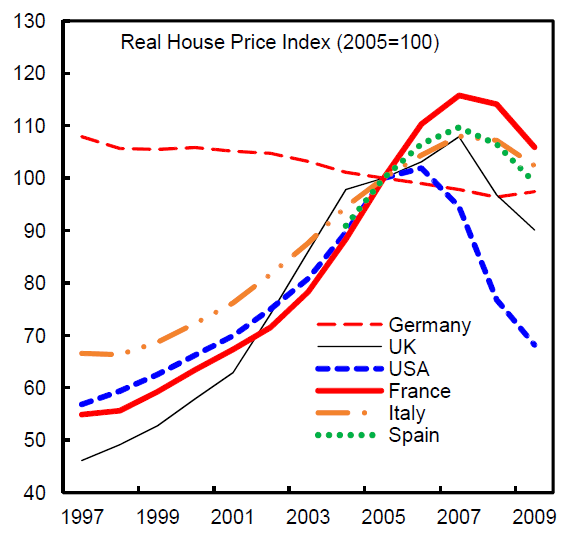
Any explanation of the Housing boom and bust should be able to explain why it was global in nature.
Without saying so, the importance of this challenge is to explain how Fannie, Freddie and the CRA were uniquely responsible for the housing credit crisis when no country in the rest of the world had any Fannie, Freddie or CRA of their own yet produced this similar result, with data from the IMF:


The Australian analogy for the US elections is that Australians have turned away from both ruling parties in almost record amounts, yet have no Tea Party, just a "maverick", populist and failed Prime Ministerial candidate who has been seized upon as the sole reason for such a result.

But, before going to the story, a bit of background info for those unfamiliar with Australian voting rules: There, voting is mandatory, so even if you don't want to vote, you must. And if you don't like your choices, you must do something to register your displeasure which effectively voids your vote. The resulting ballot is referred to as an "informal vote". Quaint, isn't it?

Huge support for 'none of the above'
The Australian Electoral Commission yesterday said it would review the abnormally large number of informal votes cast after counting concluded to determine the cause.

Around 20 per cent of votes have not yet been counted, but early estimates indicate the final number of informal votes could be the highest in 25 years.

Adelaide University politics professor Clem Macintyre said the high level of informal votes and support for minor parties indicated widespread disillusionment with Labor and the Coalition.

"There's no question for some people, they cast a vote for `none of the above'.

"It was a very dispiriting campaign with two relatively inexperienced leaders. I don't think anyone captured the imagination of the voters.

"There was a sense of frustration and people turned up saying `I can't be bothered'."

"I wouldn't call it the `Latham effect', that just encourages Mark Latham," he said.

Informal voting hits record high
Overall, informal voting appears to be on the rise, running at 3.2 per cent for the House of Representatives in 1996, 3.8 per cent in 1998, 4.8 per cent in 2001, 5.2 per cent in 2004 and four per cent in 2007.

The AEC (Australia Election Commission) defines an informal vote as an unmarked ballot paper, one not initialled by a polling place official and which may not be authentic, onenot filled out correctly or one where the voter identifies him or herself.

That includes ballots marked with just the figure one or with ticks or crosses.

Ballot papers featuring the voter's political wit or wisdom are not necessarily informal, provided it's numbered correctly. The AEC advises voters that it's unwise to run the risk of having their vote excluded by writing on the ballot paper.

Mark Latham, always one to draw little polite criticism but much impolite outrage, has been the lightning rod of those upset at the reticence of the public to play along with the system.

Lock up the knives for loony Latham's poll dancing routine T
he bilious Mark Latham is no more a "reporter" than I am George Clooney, but in this brave new world of blogging and tweeting etc, any mug lair can call himself whatever he likes. Many do.

His descent upon the election campaign was like Looney Uncle Festus turning up unwanted at the wedding with his fly undone. Eyeballs burning, Latham radiates menace. You feel yourself hoping the knives are locked away and there's not an AK-47 or a chainsaw in reach. I never know if this in-yer-face aggro is an artfully contrived act to instil fear or whether he is just plain gaga.

But journalism it ain't. It's entertainment for dummies, as surely as if 60 Minutes had put on a pole dancer, a keg and '70s covers band.
Latham is a 'turkey'
Mr Kennett said he was concerned about public complacency on the election.

"You get that turkey Mr Latham out there saying publicly that … he'll attend a polling booth and not vote," he said. "You think of the number of people around the world who have given their left and right arms in order to have the right to vote."
Political satire provokes more than just a laugh
I was already fuming from Mark Latham's plea on 60 Minutes for Australians to hand in a blank ballot - the appearance of even more of the same, even if it was cloaked in the arch, smug sentiment you find in late-night ABC comedy - tipped me over the edge. Harsh words were bellowed at the screen. The cat went flying under the couch to hide in terror.

Yes, I understand that this election campaign has been one of the least inspiring in the last 50 years. I will give you the fact that there's been a real lack of vision on behalf of both of the major parties. But ...

Our system works.

Now, it might not work as efficiently as we'd like, or for all the people, all the time, but we're one of the most stable nations in the world. We're a success story. We're a postergirl for the will of the people actually driving the course of a nation, regardless of whatever ideology has been in vogue. This is not something to be taken lightly. We're one of a few green LEDs in a panel filled with red.

Democracy only works because it's the shared belief that every one has a voice and the ability to use it. If the media, the reflection of our society as a whole, begins to pass along the message that politics and voting doesn't matter then those most prone to those messages, the youth, will start to believe it. The last thing Australia needs is a generation of people reaching voting age who do not believe in the system, who think it doesn't work for them and isn't worth their time. They won't pay attention. Things start to get missed. And then, piece by piece, our democracy begins to weaken, fray, crack.

So guys, give it a rest. Enough already. I know that your job is to make people laugh and you're very good at that. I also understand that satire is absolutely essential to any working political system - as bacteria in the gut of the body politic. But please, don't cheapen the system as a whole.
All that said, it wasn't seriously denied that the electorate was underwhelmed by its choices.

Don't blame Latham for highlighting home truths
In a dull campaign, Mark Latham's report on 60 Minutes was one of the more interesting. But Latham had no new insight on the two party leaders

The Labor base is drifting away because it does not see this as a successful government. Labor voters feel let down by hyped-up promises that have not been delivered.
And on the other side of the isle, Coalition launch a policy-free zone
Mr Abbott offered little in the way of new policy or vision as the Liberals and Nationals gathered to officially launch their 2010 federal election campaign on Sunday.

Instead, Mr Abbott's focus was squarely on the problems facing his opponents.

With no big-bang announcements, Mr Abbott laid out his priorities for his first three months in government if he wakes up as prime minister on August 22.

High on his agenda will be a phone call to the Nauru President Marcus Stephen to begin negotiations on an offshore processing centre and a pseudo mini-budget - a statement detailing the new government's response to the risks and opportunities facing the economy.
So, if there is any significant "none of the above" result in the US this election season, that alone should not be seen as evidence of Tea Party strength. Anti-incumbency is not uniquely American; it is endemically democratic. Especially when it's the economy, stupid.


TUNE IN FOR MORE: US primaries could deal blow to anti-incumbent insurgency
Tuesday's results may predict whether insurgent candidates, especially Republicans backed by staunchly anti-government Tea Party groups, will continue to make advances over those with more moderate views.

Despite surging anti-incumbent fervor ahead of November legislative and state elections, no incumbent is expected to lose in US primary votes Tuesday, results that would deal a setback to insurgent candidates.

The Tea Party movement, which sprung up in 2009 as a grass roots revolt against Obama's tax, economic and health reform policies, has electrified the Republican Party base.

Taking its name from a revolt against British rule in colonial Boston in 1773, the group has emerged as a powerful force in nominating Republicans for November's mid-term legislative and gubernatorial elections.

Tea Party candidates have already won important Senate primary victories in Utah, Colorado, Nevada, and in other states, over more mainstream Republicans.

But Tuesday's results may show the anti-incumbent narrative has been oversold.

We shall see. Won't be long now.

Labels: , , ,

Wednesday, August 11, 2010

The left's worst enemy (as usual): the more left than thou

Liberals still steamed at Robert Gibbs Everyone seems to have a problem with the "left". The right, most certainly, where being of the left of anyone is tea for the Mad Hatter.

But there is no fury like the fury of the left of whatever against those what be right of that. And so it is that,

Liberals still steamed at Robert Gibbs
The Obama administration’s attempts to blunt press secretary Robert Gibbs’s frustrations about the “professional left” in a newspaper interview published Tuesday haven’t changed much. Gibbs’s backtracking — he said he spoke “inartfully” to The Hill — and deputy press secretary Bill Burton’s assertion that his boss “answered honestly” when he derided liberal critics, seemed only to make matters worse.

In an interview with The Hill’s Sam Youngman, Gibbs lashed out at liberal critics who have relentlessly pilloried Obama for what they view as bad compromises and broken promises, including the lack of a single-payer system in the sweeping health care overhaul, his failure to close Guantanamo Bay within a year and his addition of 30,000 troops to the war in Afghanistan. Gibbs said the left isn’t giving the president his due for preventing a national economic collapse, tightening Wall Street rules and changing the health care system — accomplishments made despite lockstep Republican opposition.

“I hear these people saying he’s like George Bush. Those people ought to be drug-tested,” Gibbs told The Hill. “I mean, it’s crazy.”

But the White House has work to do if it wants to mend fences with an influential constituency.

Michael Tomasky, a moderate voice among progressive columnists, said that though progressives have been harshly critical of the White House strategy in the past — for example, during the health care debate — “this isn’t one of those times.”

“That’s what makes me really curious about what made him unload like this,” Tomasky said. “People don’t expect everything to get done, but they can expect to be treated with rhetorical respect.”

“The president specifically asked us to push him and make him better,” said Levana Layendecker, Democracy for America’s communications director. “And we’re going to keep doing our jobs.”

Pushy. Yep, that's what Guambat reckons. That and blinkered, myopic, Darwinian-challenged, pea-brained, and principled to the vanishing point. A black hole that consumes itself and all in its orbit. They really just don't understand -- or like -- humans and their charming compromising nature.

As if pushing him alone will make him better. "Push" and "make better" are two separate things too subtle for shrill to distinguish or discriminate.

Labels:

Saturday, August 07, 2010

Good house keeping is not sweeping under the rug

Congress used to investigate.
Prominent hearings by standing committees provide lawmakers a soapbox, creating the appearance of congressional action. But without the hard follow-up work of investigations that lead to real reform, many of the nation's most pressing problems remain unresolved.

Congress used to know how to investigate. In response to events ranging from war profiteering to Wall Street excesses to espionage transgressions, Congress formed special committees. Directed by powerful lawmakers, well-staffed and armed with subpoena power, these panels provided the public valuable information about government activities and spurred important legislation.

Increasingly, though, Congress's impulse has been to outsource this job to independent commissions, which have proliferated in the decades since the Warren Commission investigated President John F. Kennedy's assassination. Today, when faced with a crisis, Congress -- or the president -- appoints a commission, waits for its report and then, most of the time, files it away to obscurity.

In 1941, the Senate created a special Committee to Investigate the National Defense Program. With Truman as its chairman, the panel held hundreds of hearings and traveled to defense manufacturing sites across the country. As a result, the government began to hold defense contractors accountable for cost overruns, criminal misdeeds and unsatisfactory work. It is estimated that the committee saved the government as much as $15 billion (in World War II dollars) over the course of the war and saved the lives of many soldiers who would otherwise have been armed with defective weapons, machinery and gear.

In December 2006, House Speaker Nancy Pelosi, calling the corruption in Iraq and Afghanistan war contracting "staggering" and "breathtaking," told reporters that the country needed something similar to the Truman Committee. There remains a desperate need for such oversight today. A committee with the power to conduct a far-ranging investigation would let contractors know that someone is watching.

See: When interrogation is terror -- and when it is not

Labels:

Monday, July 19, 2010

Blameless in Chicago

And too bloody right, Mate!

After only 18 months in office, Americans Blame Bush, Not Obama, for Deficit, Jobs, Afghan War

The former Republican president is blamed more than President Barack Obama for the budget deficit, unemployment and illegal immigration, according to a Bloomberg National Poll conducted July 9-12.

Most surprising is that 60 percent say Bush is primarily responsible for the current situation in Afghanistan.

“They spent a decade driving the economy into a ditch,” Obama, 48, said at a Las Vegas fundraiser on July 8 for Senate Majority Leader Harry Reid of Nevada. “And now they’re asking for the keys back. And my answer is, ‘no, you can’t have the keys. You can’t drive. You don’t know how to drive. You drive in the wrong direction.’”

Of course, Obama hasn't yet shown he -- and more importantly the Democratic Party -- knows the way home, either. We need to see better leadership on banking regulation, immigration, health care, stewardship of the environment and economy, and our global standing. Start with cleaning house with a complete sweep of anyone or anything Goldman Sachs related.

These problems didn't start 18 months ago, and could not be solved by anyone in the remaining 30 months, but we need to be better positioned than a rolling stone.

How does it feel
To be on your own
With no direction home
Like a complete unknown
Like a rolling stone ?

Labels:

Thursday, July 01, 2010

Read my lips -- who speaks for a corporation?

Now that the Supreme Court has given a dollar an equal vote to a person, some states are requiring corporations to take into account the owners' views. Surely in a management society (which was really what the Bush Ownership Society was all about), that is plum downright un-American!

State Lawmakers Move to Limit Corporate Clout (WSJ ticket req'd.)
State lawmakers in New York and Massachusetts are advancing legislation that would put hurdles in front of companies engaging in political activity.

In doing so, the lawmakers say they are attempting to contain the consequences of January's landmark ruling by the Supreme Court in Citizens United v. Federal Election Commission that overturned federal limits on corporate political expenditures. The efforts were assailed by business groups.

Democratic leaders of the Assembly and Senate in New York this week quietly introduced a bill that would require corporations to get approval from shareholders before spending money on campaigns or issue advocacy.
How dare they?!
"It's unconstitutional on its face," said Heather Briccetti, vice president and general counsel to the Business Council of New York State. "It would pretty much bar any larger publicly traded entity from participating in the political process in this cycle."

Floyd Abrams, a prominent First Amendment lawyer, said the provisions under consideration in the statehouses didn't appear to be violations of free speech, but raise questions.

"States do have considerable powers to assure that shareholders' views are taken into account with respect to topics such as this," Mr. Abrams said. "What they can't do is burden the First Amendment."

Said Mr. Abrams: "The question is, when you do this, are you in effect loading the dice against a corporation's exercise of its First Amendment rights?"

When a corporation spends its money to speak its political mind, who speaks for the corporation speaks: the shareholders or management?

One of Guambat's Opuses in the right-side column gives away the clue to his opinion:
Unrepresentative swill (Part 3)

Labels: ,

Saturday, June 19, 2010

A government of the dollar, by the dollar and for the dollar

The banking industry, especially Big Banking, isn't very popular amongst the voters, yet Congress is "finding" it difficult to pass through any meaningful and effective reform that targets the excesses and deregulation that nearly made the Great Depression seem not so great as the Big Dipper Recession we're now experiencing in all industrialized countries world wide.

Similarly, the Drill Baby Drill crowd and the fossil fuel industry, especially Big Oil, isn't very popular at the moment amongst the voters, yet Congress and the administration is "finding" it difficult to say or do much to take any meaningful and effective measures to target the free reign and sham regulation of the oil industry that made the Exxon Valdez look like spilled milk compared to the Deepwater Doodoo.

But if the disgusted voters are not able to make their sentiments known, what is holding them back?

Big Money.

Lotsa Big Money from Big Banks, Big Oil, and Big Pharma, spread, like farmers fertilizing their fields, by lobbyists and their phony phinancial phronts. That and the Business-as-Usual state of governance that passes for our elected leadership in Congress.

Donations Create a Tricky Balance for Oil-State Politicians

For the last decade, the oil industry has been one of the most powerful lobbying constituencies in Washington. It has spent nearly a billion dollars on federal lobbying since 1998, according to the Center for Responsive Politics, making it the sixth-biggest industry in terms of expenditures.

In the current election cycle, the oil and gas industry has contributed $12.8 million to Congressional candidates, with 71 percent of it going to Republicans.

The outburst by Representative Joe L. Barton of Texas in support of BP underscored the potential peril for lawmakers forced to respond to crises involving industries vital to their regions, and whose bountiful donations finance their political campaigns.

But in going after Republicans, the Democrats’ attacks gloss over a more complicated picture.

The largest beneficiary of campaign donations from BP in the 2008 election cycle, for instance, was President Obama, who took in $77,000 from company executives and its political action committee. This year, Senator Blanche Lincoln, Democrat of Arkansas and chairwoman of the Agriculture Committee, leads all candidates with $286,000 in donations from oil and gas companies.

And while Democrats have pounced on Mr. Barton for accusing Mr. Obama of conducting a “shakedown” by demanding that BP set up a $20 billion fund for oil spill claims, a number of Democratic lawmakers — especially those from oil-producing Gulf states — have struggled to balance their criticism of BP with support for the industry.

Officials like Senator Mary L. Landrieu and Representative Charlie Melancon, both Democrats of Louisiana, have demanded accountability for BP and reparations for individuals and businesses who may face financial catastrophe. But they have also fought to lift the moratorium on offshore drilling imposed by the Obama administration after the Deepwater Horizon rig explosion, saying it is crippling the local economy.

Both Ms. Landrieu and Mr. Melancon, who is running for a Senate seat, receive substantial donations from the oil and gas industry, which is hardly surprising given the industry’s big presence in Louisiana. For her campaigns, Ms. Landrieu has taken in $751,000 since 1996, while Mr. Melancon has received $312,000 since 2004.

To put this in the broader context that Guambat began this post, the NYT piece notes,
The tightrope walk faced by elected officials from oil and gas states is similar to the New York delegation’s struggles when it comes to legislation to regulate Wall Street banks, or the New Jersey delegation’s sensitivity on legislation related to the pharmaceutical industry.

“You’ve got this conflict for these folks where they acknowledge the spill is a problem but, with the significant support they get from the industry, are a heck of a lot more reluctant to take aggressive legislative action against the company,” said Tyson Slocum, who runs the energy program at Public Citizen, a political research and advocacy group.

In a democratic system of government, it's one person, one vote.

In the corporate world of "democracy", it's one dollar, one vote.

Big Money reflexively and diligently pursues its own sense of democracy on the People's government. For a while, the people had managed a very small curb on the Big Voice of Big money and its One Dollar, One Vote philosophy of commercial democracy.

But the Supreme Court nominees of the Bush family have now also cut back on the effectiveness of the One Person, One Vote philosophy of political democracy by giving the Big Money the vote. They've given the purely legally fictional corporate "persons" the equal protection of real, human beings.

Supreme Court's campaign finance ruling: just the facts
On Jan. 21, the US Supreme Court announced a landmark decision establishing for the first time that corporations enjoy the same First Amendment free-speech rights as individuals.

On one side, liberal reformers have sought to limit the influence of wealthy corporate interests by emphasizing the importance of maintaining a "level playing field." If American democracy is based on the principle of one person, one vote, they say, then corporations must be muzzled during political campaigns to prevent their amassed wealth from dominating and corrupting a political campaign.

Conservatives and libertarians, on the other hand, have countered that limiting the amount of money a corporation – or anyone – can spend to make their political point is censorship and a violation of the letter and spirit of the First Amendment's guarantee of free speech.

Lest we go down any path toward thinking this is just a Republican thing, consider this.

Did Democrats' deal with the NRA kill campaign finance reform?
The derailing this week of the House Disclose Act gave Republicans – still reeling from Rep. Joe Barton’s “apology” to BP CEO Tony Hayward this week – a rare chance to gloat about the pitfalls of cozying up to special interests.

“Van Hollen’s carve-out for special interests has proven about as popular as first-time World Cup ref Koman Coulibaly’s blown call today, which cost the United States a victory,” said House Republican whip Eric Cantor (R) of Virginia in a blog today. His barb was aimed at Rep. Chris Van Hollen (D) of Maryland, chair of the Democratic Congressional Campaign Committee.

At issue is a deal brokered by the House Democratic leadership to exempt the powerful National Rifle Association (NRA) and others from disclosure requirements in a new campaign finance law. The legislation aimed to restore campaign finance limits stripped away by a controversial 5-4 US Supreme Court decision in Citizens United vs. Federal Election Commission, which scrapped restrictions on when and how much corporations and unions can spend to influence elections.

The NRA initially backed the Supreme Court decision.

“This ruling is a victory for anyone who believes that the First Amendment applies to each and every one of us,” said NRA executive vice president Wayne LaPierre in a statement on Jan. 21. “This is a defeat for arrogant elitists who wanted to carve out free speech as a privilege for themselves and deny it to the rest of us; and for those who believed that speech had a dollar value and should be treated and regulated like currency, and not a freedom.

On May 26, the NRA had announced opposition to the bill as “intimidating speech,” but dropped opposition after the carveout.

The proposed law would ban some corporations from funding campaign ads and require others to disclose their top five donors in ads and on their websites.

“We believe voters have an absolute right to know who is spending money to try to influence their vote. And this will prevent big special interests from hiding behind front organizations, sham entities, to try and hide from the voter what they're doing. Nobody, nobody should be afraid of this transparency unless they have something to hide,” said Rep. Van Hollen in a press conference introducing the act on April 29.

But cribbing from President Obama’s playbook in cutting early deals with pharmaceutical companies and other potential opponents to move health care legislation, Democrats this week cut deals exempting the NRA as well as the Sierra Club, the Humane Society, and AARP from disclosure requirements in the bill.

“The political, special-interest nature of the legislation is reflected in the recent addition to the bill of the NRA exemption," says R. Bruce Josten, chief lobbyist for the US Chamber of Commerce.

“This ad hoc carve-out is specifically tailored to exempt the National Rifle Association from the bill’s key restrictions and burdens. The admitted purpose was to end the NRA’s opposition to the bill to secure passage,” he adds. “This is clear and unconstitutional discrimination in favor of one speaker and against others.”

Guambat was considering settling in with a warm cuppa tea to contemplate this when he realized how cozy he was beginning to get with the leanings of the Tea Party. So he grabbed a big jug of moonshine and went out onto the porch to watch the Green Flash of the sun setting over the Philippine Sea.

Labels: , ,

Friday, June 18, 2010

Too Big to Foil

Texas politicians have always stood behind their oil industrialists. So it was only to be expected that US Representative from Texas, Joe Barton, tried to foil the effort President Obama had constructed to escrow $20 Billion of BP funds to secure some of the cost of the Deepwater Doodoo cleanup.

The Houston Chronicle reported, Barton BP 'shakedown' remark draws fire
"I do not want to live in a country where any time a citizen or a corporation does something that is legitimately wrong, (they are) subject to some sort of political pressure that … amounts to a shakedown," Barton told BP CEO Tony Hayward. "So I apologize."

Barton chairs the Republican party’s top seat on the powerful House energy committee. The Jerk's kneejerk defense of Big Oil, however, proved no match, in this election year, to foil the Deepwater Doodoo cleanup plan.

The New York Times noted the immediate cleanup efforts of the Republican party, who understood the Deep Doodoo Barton had plunged into.

Republican, Under Pressure, Backpedals From Apology to BP
“I’m ashamed of what happened in the White House yesterday,” Mr. Barton said in his opening statement. “I think it is a tragedy of the first proportion that a private corporation can be subjected to what I would characterize as a shakedown — in this case a $20 billion shakedown.”

[Old Joe knows a good shakedown when he sees one:] Individuals and political action committees in the oil and gas industry have been Mr. Barton’s biggest source of campaign money, the Center for Responsive Politics reported, contributing $1.4 million since the 1990 election cycle.

Of the five Gulf Coast states, Mr. Barton’s Texas is the only one whose beaches, fisheries and tourist haunts are not threatened by oil spewing from BP’s ruined well. Republican lawmakers from Louisiana, Mississippi, Alabama and Florida quickly disavowed Mr. Barton’s apology to BP, and one was the first to call for stripping Mr. Barton of his committee seat.

Representative John A. Boehner of Ohio, the House Republican leader, and Representative Eric Cantor of Virginia, the Republican whip, summoned Mr. Barton and he “was told to apologize, immediately, or he would lose his spot, immediately,” a senior aide said.

Mr. Barton, in his [subsequent] statement, apologized “for using the term ‘shakedown’ ” to describe the $20 billion escrow account that BP and the White House announced Wednesday. He also retracted the apology to BP and said the company “should bear the full financial responsibility for the accident on their lease in the Gulf of Mexico” on April 20 and “fully compensate those families and businesses that have been hurt.”

Not to be "misunderestimated", Old Joe used what was almost a fellow Texan's Bushism to say he'd been miscontructed to the opposite effect, as reported in that Houston Chronicle piece above:
"I think BP is responsible for this accident, should be held responsible, and should, in every way, do everything possible to make good on the consequences that have resulted from this accident," Barton said. "And if anything I said this morning has been misconstrued to the opposite effect, I want to apologize for that misconstruction."

Labels: ,

Thursday, May 20, 2010

Loonier than the Mad Hatter

New hero of Tea Party Rand Paul is so conservative he scares Dick Cheney
How conservative is he? The 47-year-old Paul - who trounced establishment candidate Trey Grayson in Kentucky's GOP Senate primary Tuesday - wants to abolish the federal departments of education, commerce and energy, as well as the income tax.

Like Palin, with whom Paul now stands atop the Tea Party cake, he is opposed to all government bailouts and earmarks, and President Obama's "socialist" health care law. He favors a constitutional amendment banning abortion, even in cases of rape and incest.

But in a libertarian twist, he also favors legalizing medical marijuana.

That's not all many Americans might find slightly odd about Paul. Some of his positions frighten even staunch conservatives like former Vice President Dick Cheney, who backed Paul's GOP opponent.

"We are encountering a day of reckoning," Paul said Tuesday night in one of his many ominous, end-is-near warnings. "And this Tea Party movement is a message to Washington that we are unhappy, and we want things done differently."

Labels:

Thursday, April 29, 2010

"Inside baseball" lawyering for Senate hearings

The Blog of LegalTimes has an instructive backgrounder on some of the puppet masters who help stage events such as the recent/ongoing Goldman Sachs Senate not-hearings.

Goldman Lawyer's General Advice: Devour Senators' Time
O’Melveny & Myers partner K. Lee Blalack II spoke to The American Lawyer for a March 2009 story about what it’s like to prepare clients for a congressional hearing. His advice: a congressional hearing room is not a forum for getting at the truth. A day in the klieg lights, he said, should end with minimal damage to reputation while not complicating a client’s position in other investigations or litigation.

“Long, thoughtful pauses followed by rambling non-responsive answers can easily devour half of a member’s allotted questioning time,” Blalack told The American Lawyer, which is a sibling publication of The National Law Journal and The Blog of Legal Times.

Blalack formerly worked for the committee that’s hosting the hearing, the Senate’s Permanent Subcommittee on Investigations.
Much more in the link.

Labels: ,

Wednesday, April 21, 2010

With a gun to its head, Wash D.C. surrendurs its seat

Rosa Parks sparked a civil rights revolution in America when she refused to give up her seat.

The people in the District of Columbia, a territory of the US, fed up with the shootings that have turned D.C. into a murder capital, have had to again give up any hope of having a seat on the Federal floor of the House of Representatives because they refused to give up their gun control laws.

Ardent supporters of having the seat in the House backed out, saying "they pulled the bill because of an amendment that would have repealed most of the District's gun-control laws".

Congressional leaders shelve D.C. voting rights bill
House Majority Leader Steny H. Hoyer (D-Md.) abandoned the long-sought legislation with the blessing of Del. Eleanor Holmes Norton (D-D.C.), who had pushed for the measure.

Norton said the "egregious changes" by Reps. Travis Childers (D-Miss.) and Mark Souder (R-Ind.) would "directly proliferate guns throughout the District," in addition to eroding support for the bill among liberal Democrats, particularly in the Senate. Norton said that legislation would have restricted the District from prohibiting concealed or openly carried firearms.

The decision by congressional leaders Tuesday to shelve a D.C. voting rights bill, just days after announcing plans to move ahead, scuttles what supporters say was the best opportunity in a generation to give the District a voting seat in the House of Representatives.

"The price was too high," Hoyer explained during a news briefing in which he said he was "profoundly disappointed" at "his inability to get this legislation passed."

As Hoyer was making his announcement Tuesday, D.C. Council members at the other end of Pennsylvania Avenue were decrying the gun amendment during a breakfast meeting. They called it an infringement on the city's limited powers of self-government and spoke passionately about District residents who have died from gun violence, including the four teenagers killed in a drive-by shooting on South Capitol Street last month.
Guambat is acutely sensitive to the quest for representation in the US government by another US territory. Being a Guam resident, and along with a population soon to be in excess of 200,000 citizens, Guambat also has no direct representation on the House floor. He can't even vote for President.

You'd think, in such circumstances, especially in D.C. where most Congresspeople have to go to work, they'd want to keep guns out of the hands of angry and other dysfunctional people. Remember what the Boston Tea Party led to.

Labels: , , ,

Health care reform with a grain of salt

The Tea Party Democrats and Republicans did their dead level best to derail health care reform, in one aspect, but ...

Lawmakers urge FDA to move swiftly to limit amount of salt in foods
Two members of Congress urged the Food and Drug Administration on Tuesday to move quickly to limit the amount of salt in processed foods, calling the matter a "public health crisis" that demanded a swift response from government.
The analogy is chuckle-able in Guambat's delinked mind.

Labels: ,

GOPsmacked SEC/Goldman case

The Republicans seem hellbent on aligning themselves with the masters of the imploded credit universe, which of course is their right. Their far right.

No one wading through the finance of mass destruction would fail to take note of the cynical, pernicious and central role of the derivative houses that used to be called investment banks until, to get bail out money, they morphed into bland banks, and after they got that money, they bailed out again from bank to continue their business as usual. Goldman was central to this, if only because they were more politically structured and legally astute, and last standing.

Buffett warns on investment 'time bomb' March 2003
The rapidly growing trade in derivatives poses a "mega-catastrophic risk" for the economy legendary investor Warren Buffett has warned.

The derivatives market has exploded in recent years, with investment banks selling billions of dollars worth of these investments to clients as a way to off-load or manage market risk.

But Mr Buffett argues that such highly complex financial instruments are time bombs and "financial weapons of mass destruction" that could harm not only their buyers and sellers, but the whole economic system.

The derivatives market has exploded in recent years, with investment banks selling billions of dollars worth of these investments to clients as a way to off-load or manage market risk.

But Mr Buffett argues that such highly complex financial instruments are time bombs and "financial weapons of mass destruction" that could harm not only their buyers and sellers, but the whole economic system.

Derivatives also pose a dangerous incentive for false accounting, Mr Buffett says.

The profits and losses from derivates deals are booked straight away, even though no actual money changes hand. In many cases the real costs hit companies only many years later.

This can result in nasty accounting errors. Some of them spring from "honest" optimism. But others are the result of "huge-scale fraud", and Mr Buffett points to the US energy market, which relied for most of its deals on derivatives trading and resulted in the collapse of Enron.

Some derivatives contracts, Mr Buffett says, appear to have been devised by "madmen".
Banks Boosted by Fixed Income
Goldman Sachs Group Inc.'s fixed-income group turned in a record performance in the first quarter, underscoring the investment bank's dominance in a business that is driving Wall Street's resurgence.

At Goldman, Chief Executive Lloyd C. Blankfein has emphasized fixed-income trading after taking the job in 2006.
There are and have been derivatives in currency and commodity markets but it was the fixed income credit derivatives that brought the world's financial markets to their knees.

It was about the time that Blankfein came on board that Goldman ramped up its CDO operations in subprime debt that formulated and foisted off the Abacus and other credit schemes which fornicated the credit hungry markets.

Wall Street reform and Goldman Sachs
Partisanship in the Senate is holding up Wall Street reform legislation the same week the Securities and Exchange Commission sued Goldman Sachs for alleged fraud. The mutterings of our Readers Who Comment suggest that the discussions on Capitol Hill reflect the significant differences of opinion that exist out there in the land.

Lawmaker questions timing of SEC's Goldman case
A top Republican lawmaker is raising questions about the U.S. Securities and Exchange Commission's fraud case against Goldman Sachs Group Inc, implying political motives

Labels: ,