Monday, May 14, 2012

Austerity or Posterity: Buy now or Pay later

Europe Austerity Leading to ‘Catastrophe,’ French Lawmaker Says

Setback for Merkel as austerity agenda rejected in Germany's biggest state

Greek austerity: Path to recovery, or path to violence?

Irish pose next democratic test for EU austerity


Police clash with anti-austerity protesters in Italy


Spain: Mass Anti-Austerity Protests Sweep Nation

We need a British austerity revolt

Default now or default later?

“I had no idea.”
Unless the rich and poor encounter one another in everyday life, it is hard to think of ourselves as engaged in a common project. At a time when to fix our society we need to do big, hard things together, the marketization of public life becomes one more thing pulling us apart.

“The great missing debate in contemporary politics,” Sandel writes, “is about the role and reach of markets.” We should be asking where markets serve the public good, and where they don’t belong, he argues. And we should be asking how to rebuild class-mixing institutions.

“Democracy does not require perfect equality,” he concludes, “but it does require that citizens share in a common life. ... For this is how we learn to negotiate and abide our differences, and how we come to care for the common good.”

Labels: , ,

Thursday, November 10, 2011

Like yelling "Print Money!" in a movie house

US Stocks Tumble As Italy Debt Troubles Escalate

European shares hit as Italian debt risk surges

What's Killing Morgan Stanley Today? Italy
Morgan Stanley‘s bets on Europe are hammering its shares this morning.

What’s hurting Morgan exactly? Well, a quick look at its European debt exposure shows its got loads of Italian debt on its books relative to its exposure in Greece. Morgan’s net exposure to Italy, after its hedged positions, is $1.79 billion, according to its third quarter regulatory filing.

That net exposure includes includes obligations from sovereign governments, corporations, clearinghouses and financial
institutions. Without its hedged positions Morgan’s exposure to Italy is $4.5 billion.

The irony here is that Morgan shares suffered drastic losses in September when there was speculation about its exposure to French banks. In September financial blog ZeroHedge said Morgan’s exposure to French banks was 60% greater than its market cap and more than half its book value. That sent Morgan shares under $13.

The moves in its shares prompted an internal memo from CEO James Gorman who attempted to quell rumors. “In fragile markets, where fear triumphs over common sense, these things are bound to happen,” Gorman wrote. “It is easy to respond to the rumor of the day, but that is not usually productive.”

Italy Bond Attack Breaches Euro Defenses, Contagion Worsens
“The house is on fire,” said Dante Roscini, a lecturer at Harvard Business School and former chief executive officer of Morgan Stanley in Italy.
“The ECB needs to print money and buy Italian bonds, it’s the only way to put the fire out.”

Is Morgan Stanley the next MF Global?

Labels: ,

Wednesday, July 06, 2011

Of banks and bailing wire

File this under financial wizardry, of the sovereign kind, with a European flair.

Is the European Union bailing out Greece?

Euro zone approves 12bn euros bailout for Greece
Euro zone finance ministers have approved a 12 billion euro installment of Greece’s bailout, but signaled that the nation must expect significant losses of sovereignty and jobs.

Ministers in the Euro-group gave the go-ahead for the fifth tranche of Greece’s 110-billion-euro financial rescue agreed last year, and said details of a second aid package for Athens would be finalized by mid-September.

But within hours of Saturday’s decision, Eurogroup chairman, Jean-Claude Juncker, warned Greeks that help from the EU and Inter-national Monetary Fund (IMF) would have unpleasant consequences.

Sounds a bit like it, but it depends, to some significant extent, on how you define "bail-out". And definition is everything in A Europe of judges.

EU: No-bailout rule III
In the Treaty establishing a Constitution for Europe the provisions on economic policy were located in Part III ‘The policies and functioning of the Union’, Title III ‘Internal policies and action’, Chapter II ‘Economic and monetary policy’, Section 1 ‘Economic policy’.

The ‘no-bailout’ clause is found in Article III-183, OJ 16.12.2004 C 310/78:

Article III-183 Constitution

1. The Union shall not be liable for or assume the commitments of central governments, regional, local or other public authorities, other bodies governed by public law, or public undertakings of any Member State, without prejudice to mutual financial guarantees for the joint execution of a specific project.
'No Bailout' Clause? The EU's Greek Rescue Problems
European Policy Centre CEO Hans Martens is referring to the 'No Bailout' clause in the European treaty. Article 103 says that: the Union shall not be liable for or assume the commitments of central governments.

This article was specially written to leave ensure no EU country would be saved by the EU if it doesn't respect the Union's economic rules. And that's precisely the case in Greece.

On the other hand, if the European leaders are really willing to aid Greece, they can simply ignore the first clause and go with article 122, which states: when a member-state 'is in difficulties or is seriously threatened with severe difficulties caused by natural disasters or exceptional occurrences beyond its control, the Council [of national governments], on a proposal from the Commission, may grant, under certain conditions, Union financial assistance to the member-state concerned.

ECB's Stark rejects EU guarantees for Greek debt
A senior European Central Bank policymaker rejected the idea of a Greek debt solution involving EU guarantees on Wednesday, and said Greece would face economic collapse if it restructured its debt.

Asked about a scenario under which banks exchanged their Greek bonds for new paper backed by guarantees from EU states - an approach that would be similar to that used in Latin America in the 1980s - Juergen Stark said: "This instrument is disqualified."

"It would break the ban on support - the no bail-out clause in article 125 of the EU Treaty," Stark, a member of the ECB's Executive Board, told German newspaper Die Zeit in an interview.

The U.S.A. and Europe Are Reaching the End of the Line
Because of the sins of the € Commission, the European Central Bank (ECB), and the governments, which have repeatedly violated the no-bailout clause of the European Union's Maastricht Treaty with their so-called rescue packages, plus the ECB's acquisition of toxic government bonds, a situation has now arisen in which the ECB could become technically bankrupt overnight.

UPDATE 1-Finland demands bailout guarantees, bank participation
Finland's new finance minister said on Tuesday that the Nordic country will demand guarantees if it participates in any new euro area bailouts and that it wants private investors to bear more of the burden.

"We want to limit Finland's responsibilities. The new government has taken a tougher stance than the previous government regarding crisis countries' aid packages," Jutta Urpilainen said in a television interview with public broadcaster YLE.

She said the guarantees could be in the form of shares in a company managing the debt-laden state's property.

UPDATE 1-S&P warning adds default threat to Greece's bailout woes
Greece would likely be in default if it follows a debt rollover plan pushed by French banks, S&P warned on Monday, deepening the pain of a bailout that one European official said will cost Athens sovereignty and jobs.

Derivatives industry body ISDA said before the French proposal was released in late June that a voluntary agreement to roll over Greek debt would "typically" not trigger payments on credit default swaps.

European politicians and bankers had expressed confidence last week that the French proposal would not trigger a default, but ratings agency Standard & Poor's said it would involve losses to debt holders, most likely earning Greece a "selective default" rating. S&P cut Greece's sovereign rating to "CCC" last month, from "B", on a view that any restructuring of the country's massive debt load would count as an effective default.

Greece crisis: German lenders 'join rollover plan'
German lenders and insurers have agreed to participate in a plan to continue lending to Greece, according to German finance minister Wolfgang Schaeuble.

He was speaking after a private meeting of the country's main banks.

Mr Schaeuble said German institutions would contribute 3.2bn euros ($4.6bn, £2.9bn) to the plan, details of which have yet to be finalised.

It comes after French banks agreed to relend about half of Greek debts they own coming due by 2014.

Deutsche, Germany's biggest lender, was expected to contribute less than 1bn euros to the plan, according to reports in Germany.

Commerzbank , Germany's second-biggest lender, is likely to contribute far less than 1bn euros, the reports said.

The French plan is designed to make Greece's debtload more manageable in a way that would not be deemed a formal default.

If the deal is classified as a default by ratings agencies or credit derivatives traders, it could force European banks to recognise billions of euros in losses in Greek debts that they currently hold, putting their own solvency at risk.

A couple of years ago, ECB warns Germany against EU bail-out
The European Central Bank gave a thinly veiled warning to the German government on Friday not to violate the European Union’s “no bail-out” clause, which prevents members of the eurozone from supporting other members that are facing rising public debt.

Jürgen Stark, ECB executive board member, told Spiegel magazine in an interview released on Friday that the clause was an “important basis for the functioning of the monetary union”.

The warning follows reports that Germany was considering ways to help members of the eurozone that are facing fast-rising refinancing costs as investor fears rise about deteriorating public finances.

The “no bail-out” clause of the EU treaties prohibits countries from becoming “liable for” or assuming “the commitments” of other governments and is regarded by the ECB as an important weapon for ensuring fiscal discipline.

Asked about the issue on Friday, Frank-Walter Steinmeier, foreign minister, said; “A process is now starting to consider to what extent support via the eurozone and the economically strong countries of the eurozone can happen.”

Fast forward back to the present, German court considers challenge to EU bail-outs
Germany's Constitutional Court is hearing a challenge to the country's participation in bail-outs of Greece, the Republic of Ireland and Portugal.

A Berlin professor argues that the process violates constitutional provisions and should be blocked.

Germany's finance minister rejected the claim, saying all rescue packages had been made on solid legal ground. Experts say the court is unlikely to block Germany's participation in the eurozone bail-outs altogether.

German court hears case against bail-outs
The signs are still that the case is unlikely to cause serious problems for Berlin – the court last year declined to issue an injunction to prevent financial transfers to Greece. Judges signalled they were sceptical that an infringement of EU law would fall under their competence. However, as one government official remarked: “The court is always good for surprises.”

A decision is expected in September or October.

Labels: , ,

Thursday, March 10, 2011

Britain's baby doomers

In the US, baby boomers are finding that their Age of Aquarius has come and gone, as retirement realities loom. Guambat has personal knowledge. For the generations that followed, including Guambat's offsprung offspring, it's a time for a bit of ribbing the old folks; they have felt (without empirical justifications, Guambat reckons) it's about time someone took the punchbowl away from the boomers.

But in the UK, the boomer doomers threaten the whole muddle class economy.

Public sector staff to be told: Work for longer and get a smaller pension
A major Government report will recommend linking the pension age – currently 60 for most state employees – with the state pension age.

It is due to rise to 68 over the years ahead, threatening the retirement plans of millions of public employees, who will also have to contribute more to their ‘gold-plated’ pension funds. And experts forecast the state pension age will continue to rise, eventually hitting 70 as Britain struggles to meet the cost of its ageing population.

State workers who can currently retire as young as 55 will have to work for many more years to secure maximum pension benefits. Even members of theArmed Forces, police and firefighters, who can currently go on full pension as early as 50, will be told they will have to wait until they are 60 before they qualify.

The dramatic move is part of a broader shake-up of state employees’ retirement funds, which have created a £1trillion black hole in the public finances.

The highest-paid public sector employees are likely to have to pay far more into their pensions as a result – around 5 per cent of their earnings.

Read more: http://www.dailymail.co.uk/news/article-1364758/Public-sector-staff-told-Work-longer-smaller-pension.html#ixzz1G9mlpw5u

Most Britons face 60 percent income loss in retirement
Almost two-thirds of people living in Britain today are likely to see a 60 percent drop in their income when they retire over the next 40 years and a plummeting quality of life, a report said Thursday.

"The UK has a distinct problem with middle-income earners who are failing to save enough and are likely to find the drop in income during retirement unexpected and unacceptable," said Paola Subacchi, one of the report's authors.

The report says the problem is worsening because of a shift from defined benefit (DB) pension schemes to defined contribution (DC) schemes, which do not guarantee a predetermined retirement income.

"Furthermore, the recent recession has highlighted how vulnerable wealth and pension funds are to economic shocks and reduced annuity conversion rates," it adds.

Middle-class Britons' meagre savings mean they will have to rely heavily on the relatively small state pension, which "only just ensures a minimum standard of living," Chatham House said.

"Some may even slip into poverty," the report adds.

If the economy fares worse over the next decades than most economists forecast, retirement incomes of the so-called squeezed middle will be pressured even more, it adds.

The report follows a warning by Labour leader Ed Miliband that low and middle-income families in Britain are facing a "cost of living" crisis which will persist for years to come.

Labels: ,

Wednesday, January 05, 2011

Teeter totter

England swings like a pendulum do,
Bobbies on bicycles, two by two,
Westminster Abbey the tower of Big Ben,
The rosy red cheeks of the little children.

-- Roger Miller

The rise and fall of nations is an old tale. And if history is any guide to the future, will continue to be the pendulum by which England, China, Russia, France, Spain, Japan, Greece, Persia, India and the USA also swing. And others yet to come.

The pendulum, as does a teeter-totter, passes through an equilibrium before careening on to a point of return. Sort of like the economic/business cycle.

Guambat has been wondering of late if the USA is approaching its point of equilibrium after having reached a high point of return?

At the risk of being tarred and feathered as Malthusian, he bases this worry on demographics. Is it any coincidence that the longest/strongest bull run in USA history coincides with the maturing of the baby boomers? Is the great bull run simply an unprecedented healthy and wealthy population bulge that turbo charged the consumer-driven economy? If not, then might the pendulum swing the other way with the aging of them? Think Japan (see, Getting a bit long in the ha), a population hit by the ray gun in "Honey, I Shrunk the Kids".

Adding to this worry are two stories in the Financial Times this weekend:

In the grip of a great convergence By Martin Wolf
Convergent incomes and divergent growth – that is the economic story of our times. We are witnessing the reversal of the 19th and early 20th century era of divergent incomes. In that epoch, the peoples of western Europe and their most successful former colonies achieved a huge economic advantage over the rest of humanity. Now it is being reversed more quickly than it emerged.

What is unprecedented this time is not convergence, but the scale. Suppose China were to follow Japan’s path during the 1950s and 1960s. Then it would still have 20 years of very fast growth in front of it, reaching some 70 per cent of US output per head by 2030. At that point, its economy would be a little less than three times as large as that of the US, at PPP, and larger than that of the US and western Europe combined.

China is today where Japan was in 1950, relative to US levels at that time. But its output per head is far higher in absolute terms, since US levels have themselves risen threefold. Today, China’s real GDP per head is roughly where Japan’s was in the mid-1960s and South Korea’s in the mid-1980s. India’s are where Japan was in the early 1950s and South Korea in the early 1970s.

In short, today’s divergent rates of growth between successful emerging economies and the high-income economies reflects the speed of the convergence of incomes between them. This divergence in growth is staggering.

The great convergence is a world-transforming event. Today, the west – defined to include western Europe and its “colonial offshoots” (the US, Canada, Australia and New Zealand) – contains 11 per cent of the world’s population. But China and India contain 37 per cent. The present position of the former group of countries will not be sustained. It is a product of the great divergence. It will end with the great convergence.
Asia: the rise of the middle class By David Pilling, Kathrin Hille and Amy Kazmin
Until recently, many economists were openly sceptical about the idea that China, or any other emerging Asian economy, could spirit a sizeable consuming class from the mass of poverty at the base of the social pyramid. But that scepticism is beginning to fade.

This year could be the one when talk of Asia’s export-led development begins to give way to a realisation that much of the region’s future growth will be self-generated. That could even begin to address the global imbalances resulting from Asia’s export-led model that have been at the heart of the global financial crisis.

Not only in China but in countries including India, the world’s second most populous; Indonesia, a fast-growing nation of 240m; and Vietnam, 85m-strong and following in China’s developmental footsteps, the consuming class is beginning to grow. Even in less obviously successful economies such as the Philippines, which has a population of nearly 95m, years of steady if sub-optimal growth are creating pockets of broader affluence.

The emergence of a middle class in Asia beyond the prosperity that already exists in Japan, South Korea, Taiwan, Singapore and Hong Kong will have far-reaching consequences. With growth likely to be anaemic in Europe and possibly America for many years to come, businesses from food to insurance are desperate for new consumers with money to spend. Many may find the opportunity they need in Asia.

In truth, it is not so much a worry as a wonder. A wonder of what that world will look like. A wonder of what its consequence might be for Mrs and Mr Guambat, and their kids and generations. A wonder more filled with a yearning to participate than a fear of loss, but not devoid of the latter, either.

Labels:

Wednesday, November 10, 2010

And would you like fries with that?

QE2= a mere $600 billion dollars, right?

McDonalds sells 75 hamburgers per second.

They sell at least 6,480,000 hamburgers per day, per this.

Suppose'n one burger at Macca's sold for a dollar.

Guambat remembers when you could one for 29¢. And 5 fishburgers for a buck on meatless Fridays.


He even remembers when keyboards had a ¢ symbol on them. Where has that gone?


How long would it take the world to eat through a QE2 pile of burgers?

Guambat reckons about 254 years.

And they better get crackin'.

'Cause it's going to be a hard thing to swallow.

Labels: ,

Tuesday, November 09, 2010

Strange bedfellows doth economics make, QE2 edition

Here, we have Fox News backing Obama (that's backing, not bagging), and Sarah Palin bagging the US Federal Reserve Chairman (that's bagging, not backing). And other sorts joining in higgledy-piggledy.

Fox News: Obama Cranks Up Currency Heat on China as Gold, Oil Prices Soar
President Obama found himself in India Monday on the defensive over the Federal Reserve's decision last week to print more money -- a move Fed Chairman Ben Bernanke insists will stimulate an economy stuck in neutral.

Obama's comments came in the face of stepped up criticism from China, Russia and Germany over the Fed's decision. "We can't continue to sustain a situation in which some countries are maintaining massive [trade] surpluses, others massive deficits, and there never is the kind of adjustments with respect to currency that would lead to a more balanced growth pattern."

And here's Sarah, in The Guardian: Palin takes potshot at $600bn QE2
Tea Party darling Sarah Palin joins Chinese and Germans in criticising resumption of quantitative easing, telling Fed chairman Ben Bernanke to 'cease and desist'

"If it doesn't work, what do we do then? Print even more money? What's the end-game here? Where will all this money printing on an unprecedented scale take us? ... All this pump-priming will come at a serious price," Palin will say, according to snippets of the speech obtained by National Review.

"Everyone who ever goes out shopping for groceries knows that prices have risen significantly over the past year or so. Pump-priming would push them even higher," Palin adds.

The Wall Street Journal, which has mainly appreciated the Fed's lift of "asset prices", is even starting to feel a little less robust, but still pugnacious, in its endorsement: Fed Global Backlash Grows
China and Russia Join Germany in Scolding; Obama Defends Move as Pro-Growth

The Fed is independent, and the White House by longstanding tradition has strained to avoid any appearance of collusion or conflict. Mr. Obama said the administration doesn't comment on particular actions of the U.S. central bank, before adding: "I will say that the Fed's mandate, my mandate, is to grow our economy. And that's not just good for the United States, that's good for the world as a whole."

The prospects of the Fed flooding the financial system with money helped drive gold above $1,400 an ounce on Monday.

Other assets, such as U.S. stocks and oil, drifted back slightly on Monday after getting a big boost from the Fed's announcement last week.

Underpinning the debate is a growing sense that the international currency system, which has been based on floating exchange rates for most players for more than 30 years, is wearing out. China's policy of keeping its currency artificially low has long caused tensions that have increased of late, as other countries try to export their economies back to health. Now critics are lumping the Fed's policy, known as quantitative easing, into the same category.

In his first public comments since Mr. Schäuble's outburst, Mr. Obama seemed set to keep the heat on both Germany and China. "We can't continue to sustain a situation in which some countries are maintaining massive [trade] surpluses, others massive deficits, and there never is the kind of adjustments with respect to currency that would lead to a more balanced growth pattern."

Meanwhile, some sleeping in the big featherbed at the Fed are starting to toss and turn.

Fed Governor Warsh Slams QE: "The Federal Reserve Is Not A Repair Shop"
Excerpts from his speech:
The Fed's increased presence in the market for long-term Treasury securities poses nontrivial risks. The Treasury market is special. It plays a unique role in the global financial system. It is a corollary to the dollar's role as the world's reserve currency.

The prices assigned to Treasury securities--the risk-free rate--are the foundation from which the price of virtually every asset in the world is calculated.

As the Fed's balance sheet expands, it becomes more of a price maker than a price taker in the Treasury market. And if market participants come to doubt these prices--or their reliance on these prices proves fleeting--risk premiums across asset classes and geographies could move unexpectedly. The shock that hit the financial markets in 2008 upon the imminent failures of Fannie Mae and Freddie Mac gives some indication of the harm that can be done when assets perceived to be relatively riskless turn out not to be.

In the United States, the Fed's expanded participation in the long-term Treasury market also runs the more subtle risk of obfuscating price signals about total U.S. indebtedness. Long-term economic growth necessitates putting the U.S. fiscal trajectory on a sounder footing. The fiscal authorities need as clear an early warning system as possible, not a handy excuse to delay.

And overseas--as a consequence of more-expansive U.S. monetary policy and distortions in the international monetary system--we see an increasing tendency by policymakers to intervene in currency markets, administer unilateral measures, institute ad hoc capital controls, and resort to protectionist policies. Extraordinary measures tend to beget extraordinary countermeasures. Second-order effects can have first-order consequences. Heightened tensions in currency and capital markets could result in a more protracted and difficult global recovery. These, too, are developments that the FOMC must monitor carefully.

The Federal Reserve is not a repair shop for broken fiscal, trade, or regulatory policies. Given what ails us, additional monetary policy measures are, at best, poor substitutes for more powerful pro-growth policies. The Fed can lose its hard-earned credibility--and monetary policy can lose its considerable sway--if its policies overpromise or underdeliver. We should be leery of drawing inapt lessons from the crisis to the current policy conjuncture. Lender-of-last-resort authority cannot readily be converted into fighter-of-first resort power.

By my way of thinking, the risk-reward ratio for Fed action peaks in times of crisis when it has a full toolbox and markets are functioning poorly. But when non-traditional tools are needed to loosen policy and markets are functioning more or less normally--even with output and employment below trend--the risk-reward ratio for policy action is decidedly less favorable. In my view, these risks increase with the size of the Federal Reserve's balance sheet.

I am less optimistic than some that additional asset purchases will have significant, durable benefits for the real economy. Of course, benefits may well be more substantial than I anticipate. Lower risk-free rates and higher equity prices--if sustained--could strengthen household and business balance sheets, and raise confidence in the strength of the economy. Modestly higher rates of inflation could increase nominal growth, and ostensibly place the economy on a stronger trajectory.

But, expanding the Fed's balance sheet is not a free option. There are significant risks that bear careful monitoring by the FOMC. If the recent weakness in the dollar, run-up in commodity prices, and other forward-looking indicators are sustained and passed along into final prices, the Fed's price stability objective might no longer be a compelling policy rationale. In such a case--even with the unemployment rate still high--the FOMC would have cause to consider the path of policy.

And the Pollyanna (or disingenuous) headline of the day goes to the NYT: Fed Action Gets an Unexpected Endorsement From India
“A strong, robust, fast-growing United States is in the interests of the world,” said Prime Minister Manmohan Singh. “And therefore, anything that would stimulate the underlying growth and policies of entrepreneurship in the United States would help the cause of global prosperity.”

Mr. Singh, an economist by training, made his comments during a joint news conference here with President Barack Obama. The prime minister’s support could help the United States deflect criticism of Washington’s economic policies at the upcoming Group of 20 meeting in Seoul later this week, which both Mr. Obama and Mr. Singh will attend.

Unexpected?

Really?

Consider this story in Time: Obama Plays Well in India. What Will He Get in Return?
U.S. President Barack Obama and Indian Prime Minister Manmohan Singh have met seven times since March 2009, and they seem to be getting comfortable. On Sunday in Mumbai, Obama tried his hand at Indian folk dancing during a Diwali celebration at a local school. The usually sober, scripted Singh, meanwhile, jauntily fielded questions at a joint news conference on Monday. "We're not afraid of the K word," he said in response to a question about Kashmir. And he bluntly defended his country's much-maligned outsourcing industry: "India is not in the business of stealing jobs from the United States of America."

A few hours after Singh's Yankee plainspokenness, Obama delivered a speech to India's Parliament with a subtlety and political skill worthy of the nation's great statesmen. Obama flattered India's pride in its past, recalling Swami Vivekananda's visit to Chicago in 1893; he showed Gandhian humility, saying, "I might not be standing here before you today" had it not been for Mohandas Karamchand Gandhi's influence on the U.S. civil rights movement.

Obama then exceeded the Indian government's expectations for the trip and delivered the two most important items on India's wish list: he endorsed India's bid for a permanent seat on the U.N. Security Council and used strong language toward Pakistan, saying he would "insist to Pakistan's leaders that terrorist safe havens within their borders are unacceptable."

Read more: http://www.time.com/time/world/article/0,8599,2030114,00.html#ixzz14kmRldHX
The article then went on to discuss several items of "what the U.S. can look for in return". It was not complete. It did not include an "unexpected" endorsement of QE2.

Still, it is an interesting piece, and includes links to some really touching photos, like this one:

Labels:

Will US go all Irish on deficit, too?

We're sunk: Ireland's top economist says bank losses make bankruptcy 'inevitable'
Professor Morgan Kelly predicted that Ireland would follow Greece in seeking a humilating bail-out from the European Union due to a £60.3billion (€70billion) blackhole in its financial system.

But Prof Kelly, an economics professor at University College, Dublin, believes that Brussels will force Dublin to pay such a high price that it will 'inevitably' default on its loans.

'Our debt will rise faster than our means of servicing it and we will inevitably face a State bankruptcy that will destroy what few shreds of out international reputation that still remain,' he argued.

Unless Irish finance minister Brian Lenihan can deliver a credible plan to slash a further €6billion from public spending, Ireland could be frozen when it next tries to raise loans in the New Year, economists fear.

That would leave Dublin without the means to pay for essential public services.

Prof Kelly, who is known as ‘Doctor Doom’ for his prescient prediction in 2006 that Irish house prices would collapse, believes that Mr Lenihan’s austerity measures will ultimately prove futile.

'What is the point of re-arranging the spending deckchair when the iceberg of bank losses is going to sink us all?' he asked.

Ireland’s profligate banks have not fully faced up to the vast losses on their mortgage books, he said. As a result, the cost of cleaning up the banking system will be some £17.2billion (€20billion) higher than the government’s own £43.1billion (€50billion) estimate, Prof Kelly warned.

The eye-watering cost of purging Ireland’s crippled financial system - equivalent to nearly £13,400 for every Irish citizen - is the legacy of a decade-long property boom that imploded spectacularly in 2007.

Ireland’s budget deficit is set to rocket to an alarming 32 per cent of national output this year and more than one in eight workers cannot find a job.

Read more: http://www.dailymail.co.uk/news/worldnews/article-1327834/Irelands-economist-says-bank-losses-makes-bankruptcy-inevitable.html?ITO=1490#ixzz14iqnzSjD

Labels:

Saturday, November 06, 2010

Simply put

The "price" of oil rises, the dollar falls. Any net difference for a dollar-based investor? Obviously, not much if any. But does the illusion distort other behaviour?

Apply that basic rule of thumb, now, to stock prices, and to an extent US Treasury bond prices, which is what these posts from the excellent FT Alphaville explains.

Bernanke’s genie released
The Bernanke put — aka that almost magical and metaphysical QE2 effect — appears to be having an impact on equity options skew already.

Simply explained: skew is what happens when the price of calls does not equal the price of puts exactly. That is to say when out out-of-the-money calls cost more or less than the equivalent puts.

So essentially, skew happens when the market is willing to pay more for protection on one particular direction in the underlying than the other.

Now here’s the interesting thing. Before Ben Bernanke’s Jackson Hole speech the skew in the S&P 500 had reached very high levels, with downside protection trading very expensive.

But as a second round of quantitative easing became increasingly expected by the market, that skew began to ease significantly.

This dynamic can be observed most directly by looking at the option market’s implied volatility skew, which measures the difference between the cost of puts and calls. As illustrated below, this declined significantly following the Fed’s hint at additional QE on September 21. Why buy downside protection when the Fed has done it for you?

Which is all well and good.

But there is another point that Curnutt makes, which is that the Fed may be unwittingly displacing all that volatility elsewhere:

…it looks like there’s a divergence between currency and equity volatility. The Fed may be compressing equity volatility but it’s incentivising currency volatility in its place.

He measures this divergence by looking at the correlation between the Vix index — which is derived from the implied volatility of the S&P 500 index — and the implied volatility of the UUP dollar index ETF [see the chart in the post].

All of which makes Curnutt conclude (our emphasis):

All in all, we are left thinking that there may be a derivatives market analogue to the “law of conservation of energy”. Perhaps it reads: “volatility cannot be created or destroyed, it can only change form”.

Which has to make you ask: will the granting of the market’s wish for liquidity actually lead to a much more sinister implication elsewhere?

Unwinding the US Treasury trade
there really is something perverse about the country undertaking the biggest bout of unconventional monetary policy ending up with the steepest curve.

Flattening yield curves are theoretically meant to stimulate the economy by lowering borrowing costs. (For those wondering, steep yield curves also have some benefits — like building banks’ balance sheets back up — more on which later).

this is from Bank of America Merrill Lynch:
The highlight of the Fed’s Treasury purchase program announced yesterday is the concentration of Treasury purchases in the 5y to 10y sector. This purchase program creates a negative supply of Treasuries to the private sector in 2011.

This will be most acutely felt in the belly of the curve, which is the preferred habitat of foreign institutions. The belly of the curve is also attractive because of favourable carry and roll down due to Fed hikes that are priced into the curve from 2013 onwards.

On the other hand, demand for the long end of the curve comes mostly from pension fund flows, which tends to be sporadic. This argues for a steep 5s-30s curve in the US.

In addition, the Fed is engaged in fighting disinflation and some pickup in inflation can be welcomed by the Fed … In this scenario, the long end will reflect an addition inflation risk premium, further steepening the US curve.
So $2,500bn worth of QEasing in the States has bought the Fed a steepening yield curve. Meanwhile, such a steep yield curve works to boost bank profits by upping the amount of money they can make borrowing short and lending long.

This was also one of the reasons why some commentators believed the Fed should actually be moving to flatten the curve. Suppressing the curve, it was thought, could decrease the attractiveness of the so-called US Treasury ‘curve trade’ and force banks to actually lend to the economy.

Flattening the yield curve to make banks lend to something other than the US Treasury is predicated on there actually being some private sector demand for loans (something which is still totally unclear), of course. But it might put a stop to some of the criticism currently being lobbed at the US central bank for its QE2 policy.

The below for example, is Reuters columnist Felix Salmon’s take on a 4,000-word piece by Shahien Nasiripour about winners and losers in the Fed’s monetary policy:

It’s truly outrageous that banks are lending more money to the U.S. government than they are to all commercial and industrial borrowers combined; well done to Nasiripour for connecting these dots and for providing a much-needed dose of outrage at the way in which
Bernanke’s monetary policy simply isn’t helping the broad mass of the U.S. population
.

Labels: , ,

Tuesday, November 02, 2010

QE2 or Titanic?

Or both ?

The Titanic, of course, was dubbed "the safest ship ever built".
She was touted as the safest ship ever built, so safe that she carried only 20 lifeboats - enough to provide accommodation for only half her 2,200 passengers and crew. This discrepancy rested on the belief that since the ship's construction made her "unsinkable," her lifeboats were necessary only to rescue survivors of other sinking ships. Additionally, lifeboats took up valuable deck space.

The QE2 is also a bit of a legend, dubbed "the greatest ship the world has ever known". She is now a drydocked hotel-in-waiting, intended to service the Palm Jumeirah in Dubai in another display of the Encore of Excess. She is owned by Nakheel, the Dubai company. Remember Nakheel?

Both ships serve as sort of a metaphor for the Monitization of Debt policy of the US Federal Reserve Board, which is expected to be revealed real soon like. Some folk are referring to it as a sort of Corruption of the Currency.

When Guambat thinks about it, he thinks of those glorious times back some fifty plus years ago in middle school days when he got a goody-two-shoes job in the Principal's office, which quarantined him from the boring class room. The job: running the mimeograph machine, cranking away while getting high and giddy on the addictive smell of the copier chemicals.

Guambat reckons Mr. Bernanke shares a similar addiction. Having run off 1.5 Thrillion dollars just a year ago, he's cranking up to run off another half to one more Thrillion more.

The Joys and Horrors Of QE2 (commentary by Dan Dorfman)
In football, they call it a Hail Mary Pass -- a last-minute act of desperation in which a quarterback throws a very long forward pass which has only a minimal chance of success.

That's essentially how economist Madeline Schnapp of West Coast liquidity tracker TrimTabs Research, partially owned by Goldman Sachs, views the widely expected second round of quantitative easing, or, as it's called, QE2.

What excites so many people is that QE2 is supposed to be a significant economic booster. In brief, the Federal Reserve prints money, which is used to buy long-term debt from banks that gives them more capital to lend and lower interest rates. In turn, that injection of this liquidity supposedly will goose the economy, stimulating more job creations, more housing sales and higher wages and salaries.

The QE2 program -- estimated at between $500 billion $1 trillion -- is expected to be announced November 3 at the Fed's Federal Open Market Committee meeting.

The first such easing, QE1, an estimated $1.5 trillion, took place in March of last year. As you can tell by the ongoing sluggishness of the economy, it has hardly been a bell-ringer.

Fed Policy Generates Sharp Divisions
Proponents say buying hundreds of billions of dollars more in Treasury bonds will provide only modest support for the economy. Foes warn that it could backfire by pushing up commodity prices, sowing seeds of unwelcome inflation in the future, or by undermining confidence in the Fed's ability to manage—and eventually reduce—its holdings.

Opponents stretch across the ideological spectrum, from John Taylor, a Stanford University economist and former Bush Treasury official, to Joseph Stiglitz, the Columbia University Nobel laureate and former Clinton White House official. Mr. Taylor has said the effort, known as quantitative easing, or QE, won't work, and that the government instead should avoid raising taxes and stop imposing new regulations. Mr. Stiglitz has said QE won't work and that the economy needs a big dose of spending increases and tax cuts.

Economists don't even agree on what another round of quantitative easing would do. Bank of America Merrill Lynch expects it should help push the 10-year Treasury yield to around 2% late this year from 2.63% today. Mizuho Securities says the effect of any new asset purchases "will be limited."

In a Dow Jones Newswires survey of firms that trade directly with the Fed, economists from Nomura Securities International Inc. said another round of QE would maintain "consumer confidence on track to keep the recovery ongoing." UBS said it would help only "modestly." Deutsche Bank said purchases could hurt the economy if they push the dollar down too far.

In its first bond-buying program, which ended in the spring, the Fed bought $1.75 trillion of mortgage-backed securities and Treasurys. The move, during severe stress in financial markets, is credited with helping to pull the economy out of its downward spiral. If the Fed could cut short-term interest rates, its traditional tool, it would. But short-term rates are near zero so it is seeking an alternative strategy.

QE2 risks currency wars and the end of dollar hegemony
The Fed's "QE2" risks accelerating the demise of the dollar-based currency system, perhaps leading to an unstable tripod with the euro and yuan, or a hybrid gold standard, or a multi-metal "bancor" along lines proposed by John Maynard Keynes in the 1940s.

China's commerce ministry fired an irate broadside against Washington on Monday. "The continued and drastic US dollar depreciation recently has led countries including Japan, South Korea, and Thailand to intervene in the currency market, intensifying a 'currency war'. In the mid-term, the US dollar will continue to weaken and gaming between major currencies will escalate," it said.

Pious words from G20 summit of finance ministers last month calling for the world to "refrain" from pursuing trade advantage through devaluation seem most honoured in the breach.

"It is becoming harder to mop up the liquidity flowing into these countries," said Neil Mellor, of the Bank of New York Mellon. "We fully expect more central banks to impose capital controls over the next couple of months. That is the world we live in," he said. Globalisation is unravelling before our eyes.

Each case is different. For the 40-odd countries pegged to the dollar or closely linked by a "dirty float", the Fed's lax policy is causing havoc. They are importing a monetary policy that is far too loose for the needs of fast-growing economies. What was intended to be an anchor of stability has become a danger.

Hong Kong's dollar peg, dating back to the 1960s, makes it almost impossible to check a wild credit boom. House prices have risen 50pc since January 2009, despite draconian curbs on mortgages. Barclays Capital said Hong Kong may switch to a yuan peg within two years.

As this anti-dollar revolt gathers momentum worldwide, the US risks losing its "exorbitant privilege" of currency hegemony – to use the term of Charles de Gaulle.

The innocent bystanders caught in the crossfire of Fed policy are poor countries such as India, where primary goods make up 60pc of the price index and food inflation is now running at 14pc. It is hard to gauge the impact of a falling dollar on commodities, but the pattern in mid-2008 was that it led to oil, metal, and grain price rises with multiple leverage. The core victims were the poorest food-importing countries in Africa and South Asia. Tell them that QE2 brings good news.

It may be instructive to read up on the debate whether, or to what extent, global protectionist measures causes or potentiated the Great Depression.

Labels: , ,

Saturday, October 23, 2010

Ya feelin' lucky, punk?

John Hussman, PhD, is a good read, from time to time. His writing style is often dry and since he constrains his view of the economy to the big picture, he's not so frenetically following the many distractions of the day that a market trader might, so new themes and ideas develop slowing in his weekly diary. But, from time to time, he is well worth the read.

And this time, it is not only helpful, but he's actually got some life in his prose. Here are a few extracts.

The Recklessness of Quantitative Easing
In the movie Dirty Harry, Clint Eastwood growls his famous line "I know what you're thinking. 'Did he fire six shots, or only five?' Well, to tell you the truth, in all this excitement I kind of lost track myself... You've gotta ask yourself one question. Do I feel lucky? Well, do ya punk?"

Over the past two years, the Fed has emptied what has largely turned out to be a chamber of blanks. Its remaining credibility lies in the belief by the public that Bernanke still has a live round left to fire. Once the Fed engages in QE, a failure of appreciable improvement in U.S. employment and economic activity would result in a substantial loss of public confidence. The Fed would be wise to save whatever ammunition it has left for a crisis point when the U.S. public is in dire need of confidence.

An additional fruit of careless, non-economic thinking on behalf of the Fed is the idea of announcing an increase in the Fed's informal inflation target, in order to reduce expectations regarding real interest rates. The theory here - undoubtedly fished out of a Cracker Jack box - is that lower real interest rates will result in greater eagerness to spend cash balances.

Unfortunately, this belief is simply not supported by historical evidence. If the Fed should know anything, it should know that reductions in nominal interest rates result in a lowering of monetary velocity, while reductions in real interest rates result in a lowering of the velocity of commodities (commonly known as "hoarding").

A second round of QE presumably has two operating targets. One is to directly lower long-term interest rates, possibly driving real interest rates to negative levels in hopes of stimulating loan demand and discouraging saving. The other is to directly increase the supply of lendable reserves in the banking system. The hope is that these changes will advance the ultimate objective of increasing U.S. output and employment.

To assess whether QE is likely to achieve its intended objectives, it would be helpful for the Fed's governors to remember the first rule of constrained optimization - relaxing a constraint only improves an outcome if the constraint is binding. This policy will be ineffective because it will relax constraints that are not binding in the first place.

On the demand side, it is apparent that the U.S. is presently in something of a liquidity trap. Interest rates are already low enough that variations in their level are not the primary drivers of loan demand.

Businesses and consumers now see their debt burdens as too high in relation to their prospective income. The result is a continuing effort to deleverage, in order to improve their long-term financial stability. This is rational behavior. Does the Fed actually believe that the act of reducing interest rates from already low levels, or driving real interest rates to negative levels, will provoke consumers and businesses from acting in their best interests to improve their balance sheets?

On the supply side, the objective of quantitative easing is to increase the amount of lendable reserves in the banking system. Again, however, this is not a constraint that is binding. The liquidity to make new loans is already present.

Despite the probable lack of measureable benefits, further QE poses significant risks. It has already triggered a steep decline in the exchange value of the U.S. dollar, and threatens a destabilization of international economic activity, a loss of confidence, and the creation of a "boom-bust" cycle threatening to choke off any economic recovery that does emerge.

The Fed might like to believe that a cheaper dollar will improve trade by increasing U.S. exports and reducing imports. However, over the past two decades, and particularly in recent years, U.S. imports have been much more elastic in response to fluctuations in the U.S. dollar than exports have been. This suggests that provoking further dollar depreciation is likely to have negative effects on the global economy, owing to a shift away from imports, but with few positive effects for U.S. economic activity. Indeed, a further depreciation would unnecessarily create a negative wealth effect for U.S. consumers facing higher prices for imported goods and services. Any improvement in the trade deficit would be largely offset by downward pressure on U.S. consumption.

As a side note, some observers have suggested that QE represents nothing more than "printing money." While this might be accurate if the Fed never reverses the transactions, the most useful way to think about QE, in my view, is as an attempt to directly lower interest rates by purchasing Treasury securities. This interest rate effect - not any major inflationary outcome - is the cause of the dollar depreciation we are observing here. There is little doubt that the effect of large continuing fiscal deficits is long-run inflationary, but as I've noted repeatedly over the years, there is little correlation between inflation and temporary - even large - variations in the monetary base. Inflation is ultimately a fiscal phenomenon born of unproductive spending, regardless of how that spending is financed.

once the Fed has quadrupled or quintupled the U.S. monetary base from its level of three years ago, how will it reverse its position? Japan was able to successfully reverse its program of QE several years ago without much impact on yields, but unlike the U.S., it had the luxury of an extremely high savings rate. With nearly 95% of its debt held domestically, Japan had no need to resort to foreign capital. In contrast, over half of the U.S. national debt is held by other countries. Without a deep pool of domestic savings, and with no repurchase agreements in place, the Federal Reserve will eventually have to entice domestic and foreign investors to buy the Treasury securities back, pressuring interest rates higher, and virtually ensuring a capital loss.

Better policy options are available on the fiscal menu. Historically, international credit crises have invariably been followed by multi-year periods of deleveraging, but measures can be taken to smooth the adjustment. The key is to focus on the economic constraints that are binding. Presently, these relate to high private debt burdens, uncertainty about income, weak aggregate demand, and the reluctance by U.S. businesses to launch new projects.

Appropriate fiscal responses include extending unemployment benefits, ensuring multi-year predictability of tax policy, expanding productive forms of spending such as public infrastructure, supporting public research activity through mechanisms such as the National Institute of Health, increasing administrative efforts to restructure debt through writedowns and debt-equity swaps, abandoning policies that protect reckless lenders from taking losses, and expanding incentives and tax credits for private capital investment, research and development.

Throwing a trillion U.S. dollars against the wall to see what sticks is not sound monetary policy. By pursuing a policy that relaxes constraints that are not even binding, depresses the U.S. dollar, threatens to destabilize international economic activity, encourages a "boom-bust" cycle, provokes commodity hoarding, and pops off the Fed's last round of ammunition absent an immediate crisis, the Fed threatens to damage not only the U.S. economy, but its own credibility.

Labels: , ,

Wednesday, October 06, 2010

Yen worthless, US$ falls, global stock markets celebrate

“This is close to a currency war”

GLOBAL MARKETS-Stocks surge, dollar falls on world stimulus hope
World stocks surged and the U.S. dollar fell broadly on Tuesday after the Bank of Japan unexpectedly cut interest rates, fueling speculation that other governments will take additional actions to reinvigorate the global economic recovery.

The BOJ's measures -- cutting its overnight rate target to virtually zero and pledging to buy 5 trillion yen ($60 billion) worth of assets -- pushed the Nikkei average .N225 to close 1.5 percent higher.

Governments' ultra loose monetary policies may debase the value of currencies and are leading to continued demand for gold and the rise of other commodities.

BOJ May Have Fired First Shot in New Round of Global Action
The renewed push for easier monetary policy comes as the International Monetary Fund warns growth in advanced economies is falling short of its forecasts ahead of its annual meetings in Washington this week. The dilemma for policy makers is that their actions may do little to revive growth and end up roiling currency markets.

“The Bank of Japan is at the head of the pack,” said Stewart Robertson, an economist at Aviva Investors in London, which manages about $370 billion in assets. “It looks like a lot of others will follow. Whether it’s right or not is another matter.”

“The bottom line for the U.S. is a growth trajectory so slow you’d nearly call it stalled,” Paul McCulley, a portfolio investor at Pacific Investment Management Co., wrote on the company’s website this week.

The revival of quantitative easing is a reversal from earlier this year, when central banks were halting stimulus or debating how to tighten policy. What’s changed is the loss of momentum in industrial economies.

“At the present time, the growth threat is more of a danger than inflation,” said Graeme Leach, chief economist at the Institute of Directors, a London-based business lobby group. “Yes, inflation is above target now. But a double-dip recession would raise the specter of deflation.”

The question for those central banks leaning toward buying more assets is whether doing so will actually bolster expansion, said Charles Dumas, director of international research at Lombard Street Research Ltd., a London-based consultancy.

“Is quantitative easing going to cause people to spend more? I don’t think so,” he said. “It does add value in reducing the risk of a downward spiral in markets.”

Another risk is that the use of unconventional monetary policy is viewed as an effort to weaken currencies to boost exports, rising competitive devaluations and protectionist responses, said Eric Chaney, chief economist at AXA Group in Paris. Japan, Switzerland and Brazil are among the countries that have already intervened in markets to restrain their exchange rates.

“This is close to a currency war,” said Chaney, a former official at the French France Ministry. “It’s not through exchange-rate manipulation, but through monetary policies.”

If you have it, the BoJ will buy it
If you live in Japan and thought about selling stuff in the closet on EBAY, hawk it to the BoJ instead. Gold is not in a bubble, money printing is.

A ticking, aging time-bomb in JGBs
Last time Japan went scouting for JGB investors, it had a plentiful resource in its own population base — all of whom were aging but were also looking for a risk-less investment until retirement day.

This time round, though, the aged Japanese pensioner is unlikely to be as enthusiastic a purchaser of JGBs simply because in many circumstances retirement day has already dawned. In fact, they’re likely to start cashing those JGBs in.
Japan’s dependency ratio is now approaching 100. This is significant. The dependency ratio is the percentage of retired people supported by working people.

Very soon Japan will have more retired people than working people, and the savings rate will fall further. This is not only an issue for the productive capital of economy, it means Japan will be in less of a position to use domestic savings to fund their burgeoning deficit. Gross debt to GDP is 200%.

BoJ says: ‘Bye, bye bank note rule’
Mrs Watanabe should be scared!

Guambat conducted an experiment wherein he laid out a piece of string in a line and tried to push it from one end. He reckons the various national currency and debt policies competing around the world will have a similar result, but worse: it will end in knots.


FURTHER READING:
The Specter of Protectionism: World Faces New Wave of Currency Wars

Labels: ,

Monday, August 23, 2010

Aussie cuppa Tea Party?

Get ready for it. Republicans and the Tea Party more particularly will be crowing with accomplishment in this political season, claiming victory for their efforts to clean House and Senate alike, along with plenty other state and local institutions.

But are their "victories" cause or coincidence?

To put this in context, consider the claims made by many of that same political persuasion that the credit crisis in the US was caused by a profligate Fannie and Freddie, as set loose on the otherwise virgin real estate markets by the Community Reinvestment Act.

Barry Ritholtz has taken apart those arguments with a number of posts to his excellent Big Picture blog, most recently this and this.

But the post most pertinent, by way of analogy, to the observation about the elections is this one, with its chart providing a thousand words of "point taken". His challenge is this:
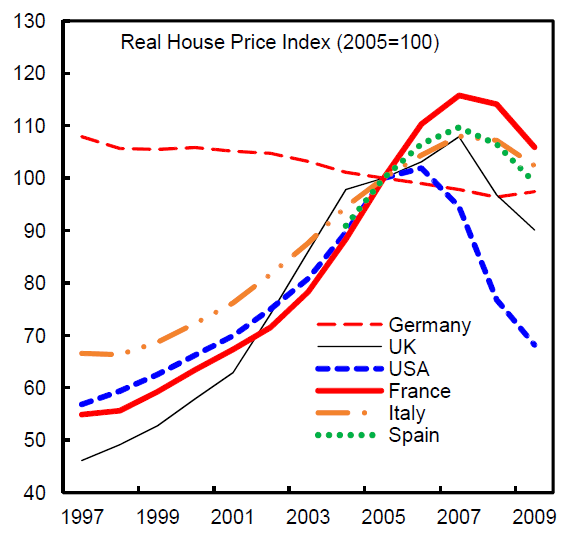
Any explanation of the Housing boom and bust should be able to explain why it was global in nature.
Without saying so, the importance of this challenge is to explain how Fannie, Freddie and the CRA were uniquely responsible for the housing credit crisis when no country in the rest of the world had any Fannie, Freddie or CRA of their own yet produced this similar result, with data from the IMF:


The Australian analogy for the US elections is that Australians have turned away from both ruling parties in almost record amounts, yet have no Tea Party, just a "maverick", populist and failed Prime Ministerial candidate who has been seized upon as the sole reason for such a result.

But, before going to the story, a bit of background info for those unfamiliar with Australian voting rules: There, voting is mandatory, so even if you don't want to vote, you must. And if you don't like your choices, you must do something to register your displeasure which effectively voids your vote. The resulting ballot is referred to as an "informal vote". Quaint, isn't it?

Huge support for 'none of the above'
The Australian Electoral Commission yesterday said it would review the abnormally large number of informal votes cast after counting concluded to determine the cause.

Around 20 per cent of votes have not yet been counted, but early estimates indicate the final number of informal votes could be the highest in 25 years.

Adelaide University politics professor Clem Macintyre said the high level of informal votes and support for minor parties indicated widespread disillusionment with Labor and the Coalition.

"There's no question for some people, they cast a vote for `none of the above'.

"It was a very dispiriting campaign with two relatively inexperienced leaders. I don't think anyone captured the imagination of the voters.

"There was a sense of frustration and people turned up saying `I can't be bothered'."

"I wouldn't call it the `Latham effect', that just encourages Mark Latham," he said.

Informal voting hits record high
Overall, informal voting appears to be on the rise, running at 3.2 per cent for the House of Representatives in 1996, 3.8 per cent in 1998, 4.8 per cent in 2001, 5.2 per cent in 2004 and four per cent in 2007.

The AEC (Australia Election Commission) defines an informal vote as an unmarked ballot paper, one not initialled by a polling place official and which may not be authentic, onenot filled out correctly or one where the voter identifies him or herself.

That includes ballots marked with just the figure one or with ticks or crosses.

Ballot papers featuring the voter's political wit or wisdom are not necessarily informal, provided it's numbered correctly. The AEC advises voters that it's unwise to run the risk of having their vote excluded by writing on the ballot paper.

Mark Latham, always one to draw little polite criticism but much impolite outrage, has been the lightning rod of those upset at the reticence of the public to play along with the system.

Lock up the knives for loony Latham's poll dancing routine T
he bilious Mark Latham is no more a "reporter" than I am George Clooney, but in this brave new world of blogging and tweeting etc, any mug lair can call himself whatever he likes. Many do.

His descent upon the election campaign was like Looney Uncle Festus turning up unwanted at the wedding with his fly undone. Eyeballs burning, Latham radiates menace. You feel yourself hoping the knives are locked away and there's not an AK-47 or a chainsaw in reach. I never know if this in-yer-face aggro is an artfully contrived act to instil fear or whether he is just plain gaga.

But journalism it ain't. It's entertainment for dummies, as surely as if 60 Minutes had put on a pole dancer, a keg and '70s covers band.
Latham is a 'turkey'
Mr Kennett said he was concerned about public complacency on the election.

"You get that turkey Mr Latham out there saying publicly that … he'll attend a polling booth and not vote," he said. "You think of the number of people around the world who have given their left and right arms in order to have the right to vote."
Political satire provokes more than just a laugh
I was already fuming from Mark Latham's plea on 60 Minutes for Australians to hand in a blank ballot - the appearance of even more of the same, even if it was cloaked in the arch, smug sentiment you find in late-night ABC comedy - tipped me over the edge. Harsh words were bellowed at the screen. The cat went flying under the couch to hide in terror.

Yes, I understand that this election campaign has been one of the least inspiring in the last 50 years. I will give you the fact that there's been a real lack of vision on behalf of both of the major parties. But ...

Our system works.

Now, it might not work as efficiently as we'd like, or for all the people, all the time, but we're one of the most stable nations in the world. We're a success story. We're a postergirl for the will of the people actually driving the course of a nation, regardless of whatever ideology has been in vogue. This is not something to be taken lightly. We're one of a few green LEDs in a panel filled with red.

Democracy only works because it's the shared belief that every one has a voice and the ability to use it. If the media, the reflection of our society as a whole, begins to pass along the message that politics and voting doesn't matter then those most prone to those messages, the youth, will start to believe it. The last thing Australia needs is a generation of people reaching voting age who do not believe in the system, who think it doesn't work for them and isn't worth their time. They won't pay attention. Things start to get missed. And then, piece by piece, our democracy begins to weaken, fray, crack.

So guys, give it a rest. Enough already. I know that your job is to make people laugh and you're very good at that. I also understand that satire is absolutely essential to any working political system - as bacteria in the gut of the body politic. But please, don't cheapen the system as a whole.
All that said, it wasn't seriously denied that the electorate was underwhelmed by its choices.

Don't blame Latham for highlighting home truths
In a dull campaign, Mark Latham's report on 60 Minutes was one of the more interesting. But Latham had no new insight on the two party leaders

The Labor base is drifting away because it does not see this as a successful government. Labor voters feel let down by hyped-up promises that have not been delivered.
And on the other side of the isle, Coalition launch a policy-free zone
Mr Abbott offered little in the way of new policy or vision as the Liberals and Nationals gathered to officially launch their 2010 federal election campaign on Sunday.

Instead, Mr Abbott's focus was squarely on the problems facing his opponents.

With no big-bang announcements, Mr Abbott laid out his priorities for his first three months in government if he wakes up as prime minister on August 22.

High on his agenda will be a phone call to the Nauru President Marcus Stephen to begin negotiations on an offshore processing centre and a pseudo mini-budget - a statement detailing the new government's response to the risks and opportunities facing the economy.
So, if there is any significant "none of the above" result in the US this election season, that alone should not be seen as evidence of Tea Party strength. Anti-incumbency is not uniquely American; it is endemically democratic. Especially when it's the economy, stupid.


TUNE IN FOR MORE: US primaries could deal blow to anti-incumbent insurgency
Tuesday's results may predict whether insurgent candidates, especially Republicans backed by staunchly anti-government Tea Party groups, will continue to make advances over those with more moderate views.

Despite surging anti-incumbent fervor ahead of November legislative and state elections, no incumbent is expected to lose in US primary votes Tuesday, results that would deal a setback to insurgent candidates.

The Tea Party movement, which sprung up in 2009 as a grass roots revolt against Obama's tax, economic and health reform policies, has electrified the Republican Party base.

Taking its name from a revolt against British rule in colonial Boston in 1773, the group has emerged as a powerful force in nominating Republicans for November's mid-term legislative and gubernatorial elections.

Tea Party candidates have already won important Senate primary victories in Utah, Colorado, Nevada, and in other states, over more mainstream Republicans.

But Tuesday's results may show the anti-incumbent narrative has been oversold.

We shall see. Won't be long now.

Labels: , , ,

Sunday, July 25, 2010

Banks: Europe not too stressed, seventh in heaven in one day in US

Euro Falls as Stress Test Results Fail to Alleviate Banking Risk Concern
stress tests of European Union banks failed to identify sources of weakness that would aggravate the region’s debt crisis. Tests show that only seven banks flunked the EU’s crisis scenario.

EU regulators scrutinized 91 of the bloc’s banks to assess whether they have enough capital to withstand a recession and sovereign-debt crisis, with a Tier 1 capital ratio of 6 percent as a floor. Governments are seeking to reassure investors about the health of financial institutions after the debt crisis pummeled the bonds of Greece, Spain and Portugal.

The evaluations took into account potential losses only on government bonds the banks trade, rather than those they are holding to maturity, according to CEBS. That means the tests are set to ignore the majority of banks’ holdings of sovereign debt, investors said.

“There’s a lack of credibility,” said Brian Dolan, chief strategist at FOREX.com, a unit of online currency trading firm Gain Capital in Bedminster, New Jersey. “They don’t think the scenarios were stressful enough.”
Europe's sovereign-debt crisis, April 29, 2010
Greece sounds three warnings that reach far beyond its borders.

The first is economic. Greece has become a symbol of government indebtedness. This crisis began last October when its new government admitted that its predecessor had falsified the national accounts.

[Guambat has just started reading the Reinhart & Rogoff treatis, This Time is Different, wherein they observe "we view the difficulties one experiences in finding data on government debt as just one facet of the general low level of transparency with which most governments maintain their books. ... Lack of transparency is endemic in government debt, but the difficulty of finding basic historical data on central government debt is almost comical."]
The second lesson is political. Playing for time has backfired. Now the mooted rescue plan has climbed above €100 billion because no private money is available. The longer euro-zone governments dither, the more lenders doubt whether their promises to save Greece are worth anything. Each time politicians blame “speculators” (see article), investors wonder if they understand how bad things are (or indeed that investors have a choice). Euro-zone leaders initially refused to seek IMF help because it would be humiliating. Their ineptitude has done far more than their eventual decision to call in the IMF to damage the euro.

This political and economic failure leads to the third Greek warning: that contagion can spread through a large number of routes.
Is a Sovereign Debt Crisis Looming?
February 2010 As the dust settles from the great financial crisis, skyrocketing government debt in advanced countries presents a new risk and is prompting calls for stimulus withdrawal. However, falling output, not stimulus spending, is by far the main cause of wider fiscal deficits. Accordingly, sustaining growth—not withdrawing stimulus—should remain most countries’ top priority if they are to break the debt spiral. Crucially, markets must remain confident in the major economies’ capacity to handle their fiscal affairs, hence the need for persuasive long-term fiscal consolidation plans.

Though markets are nervous about holding the sovereign debt of the smaller Euro area members, these countries’ problems should prove manageable—assuming the European economy continues to recover and neighbors help. Among the major economies, Japan offers the greatest source for worry in the medium term.

Since 2007, debt in seven out of the nine advanced G20 countries increased by more than 10 percent of GDP. By contrast, debt-to-GDP ratios declined or are little changed in eight of the ten emerging economies in the G20.

The bigger story is the effect of the recession on tax receipts and the automatic increase of spending on unemployment and other safety nets. Total expenditures in the United States grew from a historical average of 20.7 percent of GDP to 24.7 percent in 2009, while tax receipts are expected to fall to 14.8 percent of GDP in 2009 from an average of 18.1 percent. EU tax revenue is predicted to decline to 29.2 percent of GDP, down from 30.9 percent in 2008. Reflecting GDP decline, U.S. tax revenues fell by a remarkable 17 percent over the last year, while EU revenue likely declined by 8 percent.

With only a modest economic recovery predicted in advanced countries in 2010, government debt will continue to rise as a share of GDP.

If You Think Sovereign Debt Is Just A Greek Problem, Get Ready For It To Hit Home Soon May 7, 2010
Though the U.S. is considered to be the highest order of "prime" borrower, based on historic precedent, our debt to GDP levels are at crisis levels, and are not that much lower than Portugal or Spain. When off-budget and contingency liabilities are properly accounted for, one could argue that we are already in worse financial shape than Greece.

As Americans observe the chaos in Greece, most assume that the strength of our currency, the credit worthiness of our government, and the vast expanse of two oceans, will prevent a similar scene from playing out in our streets. I believe these protections to be illusory.

Once again the vast majority fails to see a crisis in the making, even as it stares at them from close range.

Read more: http://www.businessinsider.com/peter-schiff-sovereign-debt-2010-5#ixzz0uefPWern

Reinhart and Rogoff also make the point,
"Economists do not have a terribly good idea of what kinds of events shift confidence and of how to concretely assess confidence vulnerability. What one does see, again and again, in the history of financial crisis is that when an accident is waiting to happen, it eventually does."
And Guambat is only up to page 11.


Meanwhile, in the real world of stress testing,

Seven more US banks collapse on day of Europe's stress tests
More than 100 banks in the US have now collapsed so far this year after another seven were taken over by regulators late on Friday – the same day that seven European banks failed a financial health check.

With rising bad debts tied to commercial and residential mortgages, the number of US bank failures this year is expected to exceed last year's figure of 140. In all, the seven failed banks had total assets of $2bn.

Labels: , ,

Monday, July 19, 2010

Don't forget to eat your ECRI

Memories of Guambat's youth are fading faster than news of Obama's miracle emergence.

But he is sure he must have heard his Mum tell him to be sure to eat his ECRI. But what's an ECRI?

Now he's found out, and he's quite pleased he's avoided eating any since he left home.

A flashing red light from the ECRI
Friday’s breaking news is the annualized growth rate slowed to -9.8% from -9.1 for the week ended July 9.

At this level, the ECRI — which Lex says is noted for its prescience, longevity and impartiality in predicting business cycles — is flashing a great big warning sign that the US economy is going to double dip and head into recession.

A -10 per cent market nearly always signals a recession, apparently.

Gulp.
Click the link to see the chart. One picture is worth a thousand copyright claims.

Labels: ,

Thursday, July 08, 2010

Is the Baltic Dry Index all dried up?

At the end of 2008 Guambat began to take note of certain "anomalies" in the Baltic Dry Index and stock indexes. Then at the end of 2009, the Index proved its worth as a better index of economic health than, say, the DJIA. See the posts here.

FT Alphaville is noting that the further deteriorated Baltic Dry Index may have been a better harbinger of things in that former period than it is now. Or is it simply another case of denial?

Don’t panic, the Baltic dry is a rubbish indicator!
The Baltic Dry Index (BDI) — a measure of shipping costs for dry bulk goods — suffered its 29th consecutive daily decline on Wednesday, to record its longest losing streak in more than six years, according to Bloomberg.

It’s news that David Rosenberg at Gluskin Sheff, amongst others, managed to get pretty excited about on Wednesday. He, for example, thought it’s the sort of story that should have made the front pages by now:

The problem for the commodity complex in general is that the Baltic Dry Index, a usually reliable leading indicator, has plummeted by half since the end of May, is down now for 29 consecutive sessions and is at its lowest level in more than a year. Not to mention the fact that this is on nobody’s radar screen (page 21 news in the FT)!

And while many economists still view the index as an extremely useful barometer of global productivity trends — it appears there are some growing concerns about its usefulness today versus its usefulness say two years ago. And it’s all down to shipping supply.

Julian Jessop, chief economist at Capital Economics makes the case as follows:

The BDI is a composite measure of the cost of hiring a ship to transport dry bulk commodities such as grains, coal and metal ores. It is therefore understandable that the near-50% fall in the index since late May is attracting plenty of attention. However, there are two reasons to be wary of making big calls on commodities (or anything else) on the basis of the BDI.

But it doesn’t stop there. While the idea of a shipping index being a leading indicator might make logical sense, the BDI’s actual track record is pretty poor, says Jessop.

For instance, the best that can be said about the index is probably that it tends to move up and down at the same time as global commodity prices — hardly insightful.

For a start, fluctuations in the index could be driven by changes in the supply of shipping as well as in the underlying demand for commodities transported by sea. For example, a fall in the BDI could reflect an increase in the number of ships available to carry dry commodities (either new-builds or conversions from other uses, such as oil tankers). Similarly, the BDI might be distorted by temporary port closures, changes in the cost of fuel and insurance, and many other factors.

See Izabella Kaminska's post for more story and factoids, especially the comments.

Labels: ,