Nonfiction pulp

When it comes to beating someone to a pulp, the New Orleans Police are mere pikers (http://www.cbc.ca/cp/world/051010/w101042.html).
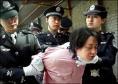
"The last time I saw Lu Banglie he was lying in a ditch on the side of the street - placid, numb and lifeless - the spit, snot and urine of about 20 men mixing with his blood, and running all over his body. I had only met him that day. He was a very soft-spoken man. Born as a peasant in Baoyuesi village in Hubei province, he was a people's representative and had been in the village of Taishi since the start of a democratic movement in the area. That movement, deeply unpopular with the local authorities, has led to beatings and mass arrests among its population as well as for observers who venture into its environs....
"Lu Banglie was at the forefront of this maelstrom. On Sunday we arrived on the outskirts of Taishi, just as the dirt roads start. There were 30 to 50 men - angry, inebriated, bored men. Most looked like thugs. Some wore military camouflage uniform, others blue uniforms with badges on the shoulders. Our taxi driver, whom we had hired randomly in a neighbouring village, was called out by the thugs who screamed abuse at him. He then screamed at us for getting him into trouble.
"We told him to reverse but by that time it was too late: the car was encircled. "Don't go out," I screamed, telling everyone to lock their doors. The men outside shouted among themselves and those in uniform suddenly left. Those remaining started pushing on the car, screaming at us to get out. They pointed torches at us, and when the light hit Lu Banglie's face it was as if a bomb had gone off. They completely lost it. They pulled him out and bashed him to the ground, kicked him, pulverised him, stomped on his head over and over again. He was unconscious within 30 seconds.
"They continued for 10 minutes. The body of this skinny little man turned to putty between the kicking legs of the men. This was not about teaching a man a lesson, about scaring me, about preventing access to the village; this was about vengeance - retribution for teaching villagers their legal rights, for agitating.
"They slowed down but never stopped. He lay there - his eye out of its socket, his tongue cut, blood dropping from his mouth, his body limp, twisted. The ligaments in his neck were broken, so his head lay sideways as if connected to the rest of his body by a rubber band....
"Random people came up to Lu Banglie and kicked him in the head, clearing their nose on his body, spitting on him, urinating on him, showing off for each other. An ambulance came. The medic got out, checked his pulse and left. They put us in a car, told us we were being taken for interrogation. On the way the men joke, laugh and we shake....
"They put us at a conference table. About 15 officials sat round it and politely questioned us, videotaping the interaction. "Why did you come to Taishi? Why did you meet Lu Banglie? How did you meet him?" they asked. The orchestrater of Lu Banglie's beating sat at the table, eyes bloodshot, arms crossed, as if to show his disinterest in us. They said we had broken the law by coming here without permission. We apologised..... "
http://www.smh.com.au/news/world/beaten-to-a-pulp-for-daring-to-push-democracy/2005/10/10/1128796467259.html
"... Violence, even through civilian proxies, is a new development in the tense relationship between foreign reporters and Chinese police, who usually simply expel journalists caught without official minders in sensitive areas after confiscating notes, tapes and images.
"But it is becoming normal for Chinese activists. About 10 days ago, security men attacked Ai Xiaoming, a professor at Guangzhou's Sun Yatsen University, and two lawyers as they left Taishi. Another lawyer, Guo Yan, who left the scene on a motorcycle taxi to seek help, was pursued by men on motorcycles and beaten up. Last Tuesday in the Linyi region of Shandong province, three Beijing lawyers were beaten up by men in civilian clothes when they tried to provide legal advice to a detained activist who had exposed abuses by local family planning officials. The lawyers were then detained overnight by police, with no apparent action taken against the attackers.
"As part of a wider crackdown on dissent in the new electronic media, Beijing this month banned several types of content, including news about protests or attempts to organise meetings through the internet or mobile telephone text messages. A popular internet bulletin board called the Yannan Forum, which followed events in Taishi, was shut down at the end of September.
"The crackdown came as the Communist Party's Central Committee met in Beijing for a four-day closed-door meeting to approve a new five-year plan supposed to bring more justice and equity to China's 700,000 villages. Taishi has become a test case for the village-level elections the Communist Party has introduced as its first tentative step in democracy.
"Villagers mounted an unprecedented recall campaign in July after suspecting their elected village chief, Chen Jinlong, of embezzling funds in the 100-million yuan ($16.2 million) transfer of 133 hectares of village land to a private developer. The campaign involved a hunger strike by hundreds of villagers, many of them elderly, which was broken up by riot police wielding batons and using water cannon.
"Guangdong, where Taishi is located, is now China's most populous province, with over 100 million people, and much of its income is derived from exports. But it has a hardline and allegedly corrupt government run by a Pyongyang-educated provincial secretary, Zhang Dejiang, and his security boss, Jiang Guifang."
http://www.smh.com.au/news/world/police-hire-thugs-to-intimidate-activists/2005/10/10/1128796467251.html
Labels: Civil liberties, Inside China
posted by Guambat Stew at Tuesday, October 11, 2005
0 comments