Thursday, June 10, 2010

A boatload of sugar helped the poison go down

AIG’s Government Rescue Had ‘Poisonous’ Effect, U.S. Panel Says
“The government’s actions in rescuing AIG continue to have a poisonous effect on the marketplace,” said the Congressional Oversight Panel panel, led by Harvard University law professor Elizabeth Warren.

“The AIG rescue demonstrated that Treasury and the Federal Reserve would commit taxpayers to pay any price and bear any burden to prevent the collapse of America‘s largest financial institutions and to assure repayment to the creditors doing business with them.”

American International Group Inc.’s bailout had a “poisonous” effect on the U.S. financial system because it demonstrated the government would protect firms from their own risk-taking.

Treasury Secretary Timothy F. Geithner said in January. Geithner, 48, executed the bailout while he led the Federal Reserve Bank of New York in 2008.

AIG leaders allowed the firm to accumulate “staggering amounts of risk” in derivatives and other areas, the panel said.

The breadth of operations weren’t “matched by a coherent regulatory structure to oversee its business.” The Office of Thrift Supervision had oversight of the parent company and failed to limit risks from swaps, the panel said.

Regulators have said that they were forced to save AIG to prevent a wave of failures that a collapse would have sparked.

The report “overlooks the basic fact that the global economy was on the brink of collapse and there were only hours in which to make critical decisions,” Andrew Williams, a Treasury spokesman, said in an e-mailed statement.

“We have learned from that experience and have been fighting for more than a year to give the government authority to put firms, like AIG, out of existence when their failure poses a danger to our economic system.”

If Congress truly has learned anything from the experience, they should be passing rock solid and loop-hole free financial reforms, including the Volker Rule, rather than continue to pander to the banking lobbyists as has been their habit.

Write your Senator, write your Congresswoman, and insist on the Volker Rule. Guambat would, but being a dual Guamanian/Australian doesn't give him any such representation.


Congressional watchdog criticizes rescue of AIG
The firm was nearly wiped out by credit default swaps, which amount to insurance [sic: in reality, bets] against the risk that mortgages and other debts will go bad. Treasury and the Fed pulled AIG back from the brink in September 2008.

When the housing market collapsed, AIG couldn't meet its obligations to its counterparties, including Goldman Sachs and JPMorgan Chase. In the bailout, the Fed paid the counterparties 100 cents on the dollar.

The government relied only on Goldman Sachs and JPMorgan to arrange a private rescue of AIG, a conflict of interest because, as AIG counterparties, "They would have been among the largest beneficiaries of a taxpayer rescue."

Labels: , , ,

Monday, May 24, 2010

Hussman takes the Ponzi out of Mr Market

John Hussman's weekly Market Comment blog must be read from time to time, but not all the time, because his world moves glacially, not in squalls. His thinking and analysis is for the big picture. If Guambat had any funds to park, he'd park them with Mr. Hussman. Unfortunately, Guambat failed the parking part of the driving test.

Guambat was delighted with the way Hussman put the right finger on the right button when he discussed the illusion behind the illusive of Mr Market, when he talked recently about taking the Ponzl out of Mr Market.
The basic problem is that Greece has insufficient economic growth, enormous deficits (nearly 14% of GDP), a heavy existing debt burden as a proportion of GDP (over 120%), accruing at high interest rates (about 8%), payable in a currency that it is unable to devalue.

This creates a violation of what economists call the "transversality" or "no-Ponzi" condition. In order to credibly pay debt off, the debt has to have a well-defined present value (technically, the present value of the future debt should vanish if you look far enough into the future).

Without the transversality condition, the price of a security can be anything investors like.

However arbitrary that price is, investors may be able to keep the asset on an upward path for some period of time, but the price will gradually bear less and less relation to the actual cash flows that will be delivered. At some point, the only reason to hold the asset will be the expectation of selling it to somebody else, even though it won't be delivering enough payments to justify the price.

Transversality forces the price of the asset to be equal to the value of the discounted cash flows.

It's not enough for a borrower to keep the payments up over the short term, and it's not enough for price of an asset to be on an upward track for a while - over time, securities actually have to be able to deliver enough cash flows to justify the price that investors pay.

When investors abandon this requirement (as they did with dot-com and technology stocks during the runup to the market peak in 2000), the price they pay stops having any relationship with the stream of cash flows that will be delivered to them over time.

An increasingly large portion of the asset price represents real money that is being paid for a "phantom asset" in the distant future, that bears no cash flows, and yet gets assigned positive value because investors assume they'll be able to sell it to a greater fool.

Mr Market is inhabited by investments and Ponzis alike; things that are investments today can become Ponzis tomorrow. Be sure you know what's in your portfolio at all times, and what it is you're chasing.

Labels: ,

Friday, April 30, 2010

You buy 2, sell 1, get one free

I’ll Tell You When Chinese Bubble Is About to Burst: Andy Xie
Another friend recently vacationed in the southern island- resort city of Sanya in Hainan province and felt compelled to visit a development sales office. Everyone she knew had bought there already. It’s either buy or be unsocial.

“You should buy two,” the sharp sales girl suggested. “In three years, the price will have doubled. You could sell one and get one free.”

The evidence in official-corruption cases no longer involves cash stashed in refrigerators or starlet mistresses in Versace clothing. The evidence is now apartments. One mid-level official in Shanghai was caught with 24 of them.

Why would corrupt officials keep apartments rather than cash? Well, according to Wall Street, the yuan is going to appreciate. So holding dollars is out of the question. And why hold Chinese cash when property prices are always going up?

Expectations of a Chinese currency revaluation are, perhaps, the most important force inflating the bubble.

A bubble evolves and bursts in its own time. When it is about to burst, I’ll let you know.
China’s lending boom, illustrated
Loan growth in China in 2009 outpaced that in other EMs, and by year-end Chinese banking assets exceeded those of the other 23 systems covered in this report, combined.

Retail lending plays little role in Chinese banks’ overall loans.

Where is all that loan growth coming from, then? Here’s another enlightening chart — on state ownership of banks. Again, China is near the top.

The reach of China’s Local Government Funding Vehicles may go well beyond the five big state-owned banks.

Oh dear.
We live in interesting times.

Labels: ,

Friday, March 12, 2010

Providing a bit of color to Lehman collapse

The coroner's report on the Lehman collapse, introduced in the last post, will be blogger fodder for days, weeks and years to come. The MarketBeat blog leads with this snippet, too:
The business decisions that brought Lehman to its crisis of confidence may have been in error but the decision not to disclose the effects of those judgments does give rise to colorable claims against the senior officers who oversaw and certified misleading financial statements.
Business decisions are matters of judgment, good or bad, and are protected from hindsight second-guessing, be they bad, by the Business Judgment Rule.

Disclosure obligations, however, do not get as much deferential treatment. If something is material, it must be disclosed.

The coroner is saying there are arguable (colorable) grounds for bringing a legal claim for nondisclosure, but not bad decisions.

Labels: , ,

Thursday, March 11, 2010

Yield not to temptation

Guambat never even took an introductory class in physics, so as best as he can understand it, according to the theory of relativity, so long as we're all going hell to beat leather, it looks to each of us as if we are all standing still.

And to investment managers, that's a nightmare. No matter how fast they can make their money grow, it ain't good enough unless it beats the other guy.

Their focus is relative growth, to prove that the nominal growth they get from doing what all the others are doing is worthless, even if those others are behaving prudently or wisely.

Absolute growth or return is unworthy so long as better relative growth or return is achievable. It sort of throws out any notion of all the other theories of portfolio management in favour of blinded one-upmanship.

And the way they measure their relative performance is usually by means of standard deviations. And, as Nassim Taleb reminded us over and over and over again, standard deviations do not account very well for the non-standard black swan, which is itself a fairly standard event.


This, of course, is old hat. It was all the talk around the tables a couple of years ago when the stock and credit markets fell into a deep hole, marked if not caused by the subprime bust and extended credit implosion. But that's all forgotten now that everyone has been bailed out by the governments around the world, right?

The overwhelming common denominator in that credit collapse was the extent to which market participants pushed aside notions of absolute returns, ignoring what is reasonable, in a mad reach for relatively higher yields, ignoring what is foolhardy.

And as Bloomberg, Barry Ritholtz and FT Alphaville have brought to our attention, the credit markets have not learned anything much from that experience.

Bloomberg:
Investors in search of better returns poured $7.8 billion into high-yield municipal bond funds last year, pushing assets to a two-year high.

Below-investment grade munis are typically issued by companies raising debt through a municipality for a project with a public interest such as hospitals, nursing homes, housing developments and sports stadiums, said Eric Jacobson, director of fixed-income research for Morningstar Inc. [In other words, these projects don't have a lot of money backing them or expected to flow from them.]

High-yield municipal bonds rated BB+ or lower by Standard & Poor’s or Ba1 by Moody’s Investors Service, one level below investment-grade debt, have returned about 31 percent in the last 12 months compared with 11 percent for investment-grade municipal securities, according to the indexes from S&P/Investortools.

High-yield municipal bonds due in 8 years to 12 years were yielding an average 6.63 percent last month, almost double the 3.42 percent on similar maturity bonds in the broader tax-exempt market, according to Barclays Capital indexes. The average dividend yield on a stock in the Standard & Poor’s 500 Index was 1.98 percent on March 9 and the average interest on a taxable money market fund was 0.02 percent as of March 2.

U.S. state and local government tax revenue fell 6.7 percent as of September from a year earlier, marking the fourth consecutive quarter of decline, according to a December Census Bureau report. That may drive defaults higher this year and next, according to Moody’s, which didn’t provide a number.

The risk of municipal-bond defaults in the future is “higher than it’s been in quite some time,” said Deutsche Bank’s Pollack, because of the unprecedented stress on state and local budgets. From 1970 to 2009, the average five-year default rate was 3.43 percent for speculative-grade debt, Moody’s said. Harrisburg, the capital of Pennsylvania, has considered filing for reorganization under Chapter 9 of the U.S. bankruptcy code as it faces $68 million in debt.

About $2.4 billion of Florida’s so-called dirt bonds, or debt to finance real-estate developments, used reserves or failed to make interest payments in November, up from $1.7 billion in May, according to Interactive Data Corp. That’s the largest amount on record and “reflects an increasing trend,” said Edward Krauss, an analyst for the Bedford, Massachusetts- based research firm, in an e-mail.

Taxing Authority

State and local governments can raise taxes and cut services to continue to pay the interest and principal on their debts, said Scott Cottier, who oversees the $6.4 billion Oppenheimer Rochester National Municipals fund of New York-based OppenheimerFunds Inc. It had a 44 percent total return in the past 12 months, the most among high-yield municipal funds, according to Morningstar.

“The fear of defaults is over-baked in the muni market,” Cottier said.


Here, Guambat would like you to refresh your coffee or drink, lie back and think of California, and reflect on a couple of posts from the last few months:
Deleveraging by default and
Oregon tosses out the first snow ball??


Barry Ritholtz
:
One of the factors that caused the great credit crisis to spread far and wide was the “reach for yield.” This is one of the most expensive ways a fixed income investor can obtain a higher potential return on their bond investments.

Note that I used the term “higher,” not “better,” and the word “potential,” not “actual.”As we have seen, high yielding junk paper often goes bust, making the yield grab an exercise in foolish futility.

Rather than accept ultra low yields as a consequence of Federal Reserve action in 2001, bond buyers poured into various mortgage backed securities. Even though they were paying 250 to 350 basis points more than Treasuries, they were rated the same: AAA.

This time, they are eschewing the fraudulent AAA ratings from Moody’s and S&P, and instead are buying naked junk. The bet is that the cities will be bailed out, and their grab for higher yield will be safely rewarded.

FT Alphaville:
while [the Bloomberg piece] does quote bullish opinion on state and local governments’ ability to keep paying interest and principal on their debts… we note that much of that opinion comes from high-yield fund managers.

Oh dear.

Labels: ,

Saturday, October 01, 2005

"Ballistic"


"The sharemarket clocked up its 10th consecutive quarterly rise on Friday, giving another strong lift to superannuation returns after a dramatic week of record gains. By the quarter's end, the local bourse was 8.9 per cent higher than its 4229-point close on June 30. "I don't think anybody thought the market would be this strong for this quarter," said Investors Mutual fund manager Jason Teh. "It has gone ballistic."

"This has been the longest consecutive stretch of gains since the 11 quarterly rises leading up to the 1987 stockmarket crash. In 2 years since March 31, 2003, the All Ordinaries index has gained 61.3 per cent.
"The last week has been ridiculous. It seems like a wad of money is just flooding into the market, I don't know where the money is coming from," Mr Teh said....

"One of the themes in the market at the moment has been a liquidity push," he said. "That and the fact people have been getting more comfortable with resources. Brokers have been upgrading iron ore and commodities forecasts on the back of the China story." Since the removal of News Corp from the ASX 200 earlier in the month, "People have been selling News Corp and ... re-weighting their funds back through the market."

Shane Oliver, head of investment strategy, at AMP Capital Investors, said the underlying rising trend in Australian equities was very strong. "While the risk of a short-term set back remains, any weakness is likely to be minor and should be used as a buying opportunity, as Australian shares are likely to continue providing good returns on a 12-month view," he said. "Thanks to strong profits and low bond yields, Australian shares are still cheap, profit growth remains robust, strong growth in China continues to augur well for resource shares, we are yet to see the sort of investor euphoria that normally characterises major share market tops and the underlying demand for shares is strong at a time when the supply of shares is actually contracting."
http://www.smh.com.au/news/business/ballistic-market-lifts-super-returns/2005/09/30/1127804659123.html

Labels:

Friday, September 30, 2005

Sawing logs

Look, if you haven't figured out by now that I am uncomfortably short in this once in a generation commodity boom, you just haven't been paying attention. If you have been, then you will understand the source of my shrill; it's called talking your book. That said, I don't intend to stop shrilling yet. Let my tombstone read: "I told you so."

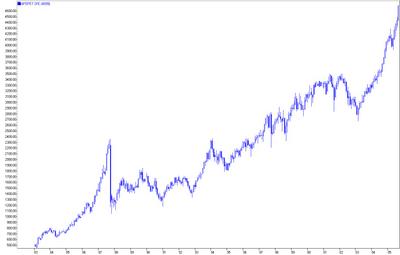
Look at the picture of the Sydney Share Price Index, going back roughly 22 years. Look at the left side and then the right side. The left side rises dramatically and then collapses in the "Crash of 1987". The right side rises dramatically and then, what?: keeps on rising dramatically?

Well, maybe. But not likely. That kind of exponential action has a way of burning out when you least expect it; regardless of whether you expect it or not. It's always a timing thing, and most people will be either too soon or too late to the party. I'm too soon, evidently, again; I always tend to hit to left field.

Putting some numbers on it, the SPI corrected from 3500 down to 2700, which it briefly pierced in March 2003. Today the SPI got to 2000 points above that low, at 4700. Recognise that the SPI is simply a derivative of the broad stock index, currently the S&PASX200, but until only a few years ago, the All Ordinaries Index. You can see a chart of the All Ords going back to 1900 from 2003 here: http://www.asx.com.au/about/pdf/all_ords.pdf

What you find is the All Ords went from effectively zero to 2700 in the 103 years shown on that chart. Then in the next 30 months it increased its value by almost another 75% (2700 x 1.74% = 4700 +/-). If the market had grown at that rate (1.75% per 30 months compounded), assuming it started at 1 (one), it would have taken a little over 40 years to reach its current level, not 105 years. The point being, it didn't, and that any such sustained rate of growth is highly fanciful.

There are those who say you can't look at the shape and extent of the current rise off 2700 to 4700 and compare it to 1987, unless you use a log scale comparison, which compares moves by their percentage gain, not their lineal, nominal gain. (Fair enough, but the percentage relationship of expecting 1.74% gain every 30 months has already shown to be pretty fantastic.)

But accepting that challenge, I've already produced that chart. See http://guambatstew.blogspot.com/2005/09/channeling-spi.html That was way back 10 days ago, on September 20, when the SPI was about 4580. See the top line of the channel going back to the '87 drop? That line has not been broken except for the rise into the '87 crash -- until now. That puts it in pretty treacherous territory.

But, it is not just territory that characterises the technical status of stocks. There is also a not very well defined concept of time. I don't have a clue what Gann was all about, but I think he did pretty solidly establish the notion that, like grieving, there is a respectable amount of time that prices (and widows) "should" stay in a range before moving on. It is the galloping and accellerating pace of this recent ascent that makes it dizzying, not simply the heights reached (or to be reached).

But don't pay any attention to my rants. I'm only talking my book. I'm not really good at technical analysis or maths. You really wouldn't want my track record in the market. And I need to do this for therapy.

There goes another of those darned pink elephants. Did anyone mention the '87 crash took place in October? Shoosh. There he goes again. Can't you control him?

Labels: , ,

Friday, September 02, 2005

Heartless mother

You'd think, with bad manufacturing numbers and tales of oil price pressures coming in before Katrina (http://quote.bloomberg.com/apps/news?pid=10000103&sid=aFduHjC9ASjw&refer=news_index), and the all the destruction and human misery brought about by Katrina, that the stock markets would show a little caution and some respectful constraint, if only to appear to be concerned for the human hardships. But no, the market is always looking to tomorrow and only suckers get trapped by the pain others are feeling today. (Note I said the pain of others: boy, the NYSE sure went into meltdown when the pain landed on their doorstep on 9/11).

This chart shows you that, by its own internal dynamics, the Dow Jones Industrials Index was drifting lower as Katrina approached New Orleans, and nothwithstanding the battering it did to Florida along the way. B
ut then, when (on 30 Aug as shown on the chart) it hit the heart of the oil and gas fields and the Mighty Mississippi River transportation hub straight in the mouth, which, disregarding the human suffering altogether, you would think would send a shuddering blow across the chops of the economy, what do the Wizzes of Wall Street do? Why, they buy like happy days are here again.

Here's what one of the Wizzes had to say about that: "Rather than just accepting my explanation that the Plunge Protection Team was aggressively buying S&P index futures, it is worth considering the explanation I received from one of my email buddies.... Apparently anybody who is short the market right now can be classified as dumb money because small traders have not been this short compared to specialists since 1943. Not even in the ’73 – ’74 time frame, when they did not have options, meaning if you wanted to be short stocks, outright sales of borrowed stock was the only method, have small traders been this short. So, not only do you have stubbornly high index related put / call ratios because of speculators and hedging strategies by the funds, we also have the small trader reading about the increasingly bad news out there and getting short like never before. Thus, a floor is put in place for stocks against the backdrop of generous liquidity provided by the Fed, and even if there is an unexpected hiccup to the downside, it’s a buying opportunity. This of course explains why the CBOE Volatility Index (VIX) remains lows, not to mention the fact speculators are long call options on this index as well, meaning in it’s own right, prices will not rise until this condition is burned off. We must congratulate the banker boys on bringing out options on the VIX. That was a stroke of genius in terms of perpetuating the squeeze. Bravo. It used to be easy making money shorting the market before conditions matured to this point, but now it’s hard. The competition is now so intense, largely brought on by the hedge fund industry, where their hedging strategies are a large part of the reason stocks remain buoyant to this day, that market returns have flattened out, causing investors to pull their money out of these heavily leveraged plays, often in favor of real estate these days. One would think that with money flow coming out of the stock market that prices would go down. But, of course it appears this process may just be starting, so in the meantime stocks can get squeezed higher...." http://www.financialsense.com/Market/hartman/2005/0831.html

And the more conspiritorial or paranoid might want consider the possibility of other "guiding hands": http://guambatstew.blogspot.com/2005/09/calvary.html

And you thought that Katrina was a b*itch.... Small traders may be feeling empathetically down off the human misery caused by Katrina, but the Big Boys have no such emotion and are setting up the small guys for a big squeeze. You can only hope the rocket scientists have miscalculated, which they have done from time to time.

Labels: , ,

Tuesday, August 23, 2005

Dot.Commodity Boom


I've blogged on previously about how the Aussie market is being carried along by a boom in resources underwritten by the China/India growth story. (http://guambatstew.blogspot.com/2005/08/got-shaft.html and
http://guambatstew.blogspot.com/2005/08/its-sure-thing.html) This chart picture is the proverbial 1000 words essay on that story. Since the 2003 lows at 2700 (about time the smart money became aware of the pending China boom), the ASX200 index has risen to 4500. That's a gain of 166.6%. In other words, in the last 2 1/2 years, the Aussie market has added two-thirds of the value it had grown over its prior entire history. It's going for the gold metal, and the silver and the bronze and the iron and the copper and the coal.... It is instructive to note that commodities make up about one quarter of the index. Almost three quarters of the rest of the market has been taken along for the ride. How many of the "investors" have been taken for a ride as well? Is this a bottomless pit? Will "the market" take profits on this almighty big bet? Or on the 3/4s non commodity part? If so, when?

And while we're on a resources theme, have a "peak" at the oil story: http://www.nytimes.com/2005/08/21/magazine/21OIL.html?pagewanted=all

Labels: , ,

Friday, August 12, 2005

Bulls in a China Shop


Standing between the end of a rainbow and Wall Street is not a wise thing to do. You'd think they'd learned after the tullip boom, let alone the tech boom, but it's just one dot-comedy after another. The rainbow now ends over China and the gold rush is now on for all things China related; witness the Baidu IPO and the Alibaba.com buy-in by Yahoo! and the unrelenting advance of the CRB Index and Australian market as big money chases coal, oil, iron ore, copper, nickel and all the base and not-so-base metals to whatever price the market will pay. Yahoo!, indeed. We've seen it before and we know this market madness will eventually end in tears, though we can hope that it also brings better living conditions to the millions of new workers in China and India and the other workshops. But at this point nobody even seems to have enough data on what the chase is about, let alone the terrain of the course, to have any idea how far they can push this fashionable theme.
Meanwhile, it's evidently Game On. There will be a lot we have to learn, and I offer the following as mere starting points.

"Rush of Chinese IPOs ‘poses threat to US investors'" http://news.ft.com/cms/s/88f823c6-0a90-11da-aa9b-00000e2511c8.html
"South China Feels Acute Labor Shortage" http://service.china.org.cn/link/wcm/Show_Text?info_id=121578&p_qry=minimum%20and%20wage
"Shenzhen Raises Minimum Wage" http://service.china.org.cn/link/wcm/Show_Text?info_id=130709&p_qry=minimum%20and%20wage
"Is China the big bubble?" http://news.cincypost.com/apps/pbcs.dll/article?AID=/20050808/EDIT/508080327/1003
"S China drivers face fuel famine" http://news.bbc.co.uk/1/hi/business/4748665.stm
"US rhetoric over China needs tempered with sound judgment - says senior US Senator" http://www.asiantribune.com/show_news.php?id=15308
"China says it’s not pushing for greater influence in Pacific" http://www.mvariety.com/pacific/pac01.htm
"More to Chinese Net stocks than just Baidu" http://www.marketwatch.com/news/story.asp?guid=%7BEB160A91%2D5F39%2D4ACE%2D9B93%2DA62BC0DD4EB9%7D&siteid=mktw
"Yahoo Buys Into Chinese Online Company" http://www.washingtonpost.com/wp-dyn/content/article/2005/08/11/AR2005081100160.html
"Those Clever Chinese" http://www.frontlinethoughts.com/printarticle.asp?id=mwo072205

Labels: , ,